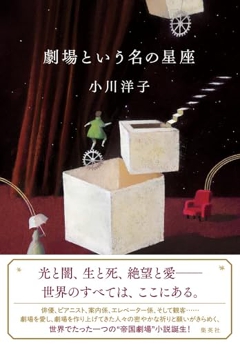
There are some puzzles in the second half of this story that I may have solved (but others may have different views).
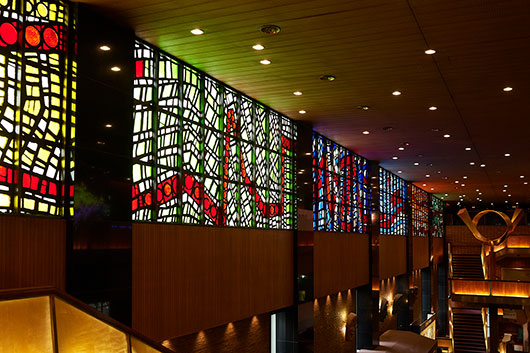
Incidentally, did anyone else look up the stained glass?
Photo from here
I can’t imagine there being a space between the panes of that window??
I found a couple of sections very hard to make sense of on first reading, and I think that maybe they make more sense now, though I’m not sure.
The first strange section is on page 65-66 [physical book] when the ghost child confides to the elevator assistant that he is searching for his mother.
The first part of this I could follow - he was abandoned as a small child by his mother and now he haunts the theatre searching forlornly for her. He is sure that he will recognise her when he finds her.
But then, he says
芝居を描くのもそのためです
That’s also why he writes plays?
Immediately after this, he talks about having lived in three houses in Taiwan, been in domestic service in Osaka, been the student of a famous poet…
None of this makes sense for a young child. I started to have the impression that this is a ghost in the form of a child, but someone who died at an older age. (Earlier in the story, I’d been troubled by all the jobs that the child seemed to have done during life, working in drug store, as a typesetter etc,)
After the curious episode in the rehearsal room, we have a reprisal of the scene with the poetry reading actor. (I didn’t understand why this came back, except maybe it is just to introduce the second poem).
Then we have another slightly cryptic poem.
This one (thanks ChatGPT) is by Emily Dickinson, and called “I’m nobody”
The translation is by a modern poet Naito Rieko published in ~2016 [which implies that most this story is set much more recently than the first one we read].
There are some very interesting comments here on the difference between this modern translation and an earlier one
『わたしは名前がない。あなたはだれ? エミリー・ディキンスン詩集』内藤里永子編訳(角川書店)★☆☆☆☆ - たむ読書日記
The significance that our narrator draws from the poem is the special secret shared between the two nobodies [nameless people in the translation, which isn’t exactly the same as a ‘nobody’]. So he imagines that the various theatre people who he especially spends time with are sharing secrets with him.
(I couldn’t decide, and I think the story is a bit ambiguous. Apart from the elevator guy, which of the other characters are able to see the ghost? He lists a number of people (including the rehearsal pianist and the backstage assistant, and the poem reader), but most of those don’t seem to be aware of his presence.)
But then there is a last section that I think casts the story in a new light.
I’m going to hide this section in case anyone wants to do some digging and puzzle this out themselves
The secret
I didn’t twig first time, but just before the end of the story we return to the funeral procession. And just as the last car disappears we are told that the boy forgets his own name. His name is carried away in the coffin, and only the nameless boy [obviously echoing the Dickinson poem] is left behind in the theatre, behind the stained glass window.
That implies that actually, the ghost child is the person whose funeral procession starts and ends the story.
So then I went searching (well, actually I asked ChatGPT), and this is the answer
Almost certainly the boy is the ghost of 菊田一夫(きくた かずお, Kikuta Kazuo, 1908–1973), one of Japan’s most celebrated twentieth-century playwrights and theatrical producers. [Wikipedia bio here]
The biographical details in the story match his life remarkably closely. This is much more than a coincidence.
1. The biographical matches
| Detail in your passage |
Kikuta Kazuo’s actual biography |
| 台湾の地で三軒の家をたらい回しにされた |
Taken to Taiwan as an infant, abandoned by his parents, and raised by several different households. |
| 大阪に奉公に出され |
Sent to Osaka as a child to work as an apprentice in a pharmaceutical wholesaler’s business. |
| 詩人を夢見て上京し |
Moved to Tokyo hoping to become a poet. |
| 有名な詩人の書生となって |
Became an apprentice to the famous poet サトウハチロー (Satō Hachirō). |
| 少しずつ芝居の世界へ入っていった |
Entered the theatrical world through Asakusa, eventually becoming a playwright and producer. |
These details are corroborated by the Hyogo Prefectural Museum of Art’s literary biography and a history of the Imperial Theatre. artm.pref.hyogo.jp
2. His connection to the Imperial Theatre
Kikuta was enormously important to the history of the 帝国劇場 (Teikoku Gekijō).
His play 『花咲く港』 (Hanazaku Minato, 1943) marked his major debut at the Imperial Theatre.
In 1955, he became a director of Toho, responsible for theatrical productions.
He subsequently helped establish the Imperial Theatre as a major venue for modern drama and musicals.
Among his achievements was bringing My Fair Lady to Japan in 1963 and adapting Gone with the Wind for the stage in 1966.
Did anyone else make sense of these mysteries (or come up with different answers)? Did you enjoy this story?