Posting this a bit early since I’m planning to travel over the long weekend…
(we agreed on keeping everything in this one thread, or do I misremember?)
Welcome to Chapter 1!
Reading
Week
Start Date
Chapter
Page Count
Week 1
Oct 04
Chapter 1
7
Participants
Mark your participation status by voting in this poll.
(Please feel free to update your status whenever you like!)
I am amazed how Ogawa manages right from the start to weave such a dense narrative, the story has just started but it already carries a somehow strangely familiar feeling with it.
Very intriguing that everybody happily helps with actively destroying their memories. Very creepy. Really sounds like a big brainwash going on here, but why? Looking forward to next week!
Regarding the chapter length, this one seems to be very short - my calculations from the digital book say ~8 pages only? I hope the lengths won’t vary too much from week to week…
(I’ve read this book a couple of years ago in English, so some of my thoughts are likely influenced by knowing more about the book. I will try to confine my comments though to the things that we have read so far)
I was reflecting that if the dominant mood of ミーナの行進 was 懐かしい, the mood here, right from the first pages is of 寂しい
The first chapter immediately catches us with something very strange. Things are disappearing from the island in acts of ritualistic collective expunging and forgetting.
It is hard to know what connects the things that are gone - ribbons, bells, emeralds, stamps, perfume. What is it that triggers the sudden mutual realisation that something must be eradicated? Perhaps most mysterious of all, once gone - even within a few days, the islanders (with the exception of the main character’s mother) seem to no longer be even capable of recalling the missing object.
(There are lots of parallels with Orwell in this book, and we have here the first clue to something that seems very like the eradication of thoughtcrime in 1984 by the removal of certain concepts from the language. But it is hard to see anything politically motivated in the removal of ribbons or perfume? unless these are somehow symptoms of bourgeois sentiments)
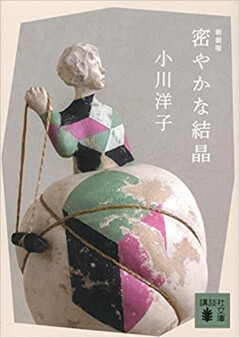
As some of you may have reflected, the title of the book is very cryptic (also very different from the English version). (Perhaps its 曖昧 nature is itself significant). I have a theory, but does anyone have any thoughts yet on the meaning of 密やかな結晶?
Glad to see some familiar faces! Thanks, @nikoru and @domjcw , for running this.
I’m immediately reminded of how much I enjoy reading Ogawa’s writing! She throws us right into this strange mystery, and yet I never get confused because she writes with careful clarity.
I have been puzzling over the title for a long time, but don’t have any theories yet.
The french title is actually a very close translation. I would suggest it has to do with the very essence of what is expurged, being somehow, somewhere refined and cristallized… but into what, and for what purpose ? For safe-keeping ? Keeping the “true” nature of the object pure ? Though it begs the question : are objects defined by their nature, or by the relationships/memories people have forged with them ?
My sense at this stage is that one potential meaning is to the process of forgetting on the island. Essences, concepts, ideas are inextricably mixed in the collective consciousness of those who live in the island - like the atoms and molecules dispersed in a liquid. But then something happens - the 密やかな結晶, and something precipitates from the mental river. At the bottom of the clear flowing liquid, some crystals form and build up on the edge of the vessel, or the bank of the river. (For a very banal analogy, anyone else have problems with limescale build-up on their kettle?) As this precipitation happens, that idea or concept is eradicated (消滅) from the group mind, and those who are part of the group are no longer even capable of thinking of that item.*
That, I think, is perhaps the literal sense of it. (It will be interesting to see if there are other echoes or meanings, as there was for Mina’s 行進).
The interesting question that we should return to in coming chapters - is what the metaphorical meaning is of this crystallisation.
I think I have finally figured out how to juggle all my book clubs, and hope to be more active here than the last few weeks ! I’ve had a look at the page numbers for the chapters. They are as follow :
Chapter
Number of pages
%
Chapter 1
7
2
Chapter 2
11
5
Chapter 3
6
6
Chapter 4
10
9
Chapter 5
20
13
Chapter 6
13
16
Chapter 7
7
18
Chapter 8
15
22
Chapter 9
11
24
Chapter 10
10
27
Chapter 11
13
30
Chapter 12
13
33
Chapter 13
26
39
Chapter 14
18
43
Chapter 15
21
48
Chapter 16
20
53
Chapter 17
18
57
Chapter 18
17
61
Chapter 19
35
67
Chapter 20
15
70
Chapter 21
13
73
Chapter 22
20
78
Chapter 23
12
81
Chapter 24
19
85
Chapter 25
19
90
Chapter 26
10
93
Chapter 27
13
96
Chapter 28
8
100
So what about the following schedule :
Week
Chapters
Pages
%
Week 1 - Oct 4th
1
7
2
Week 2 - Oct 11th
2+3
17
6
Week 3 - Oct 18th
4+5
30
13
Week 4 - Oct 25th
6
13
16
Week 5 - Nov 1st
7+8
22
22
Week 6 - Nov 8th
9+10
21
27
Week 7 - Nov 15th
11+12
26
30
Week 8 - Nov 22nd
13
26
39
Week 9 - Nov 29th
14
18
43
Week 10 - Dec 6th
15
21
48
Week 11 - Dec 13th
16
20
53
Week 12 - Dec 20th
17
18
57
Week 13 - Dec 27th
19
35
67
Week 14 - Jan 3rd
20+21
28
73
Week 15 - Jan 10th
22+23
32
81
Week 16 - Jan 17th
24
19
85
Week 17 - Jan 18th
25
19
90
Week 18 - Jan 25th
26+27+28
31
100
That’s so as to accommodate the longer chapters. Or just stick to a chapter a week ?
Alternatively, switching chapter 4 to week 2, and chapter 6 to week 3, gives :
Week
Chapters
Pages
%
Week 1 - Oct 4th
1
7
2
Week 2 - Oct 11th
2+3 + 4
27
6
Week 3 - Oct 18th
5+6
33
13
Week 4 - Oct 25th
7+8
22
22
Week 5 - Nov 1st
9+10
21
27
Week 6 - Nov 8th
11+12
26
30
Week 7 - Nov 15th
13
26
39
Week 8 - Nov 22nd
14
18
43
Week 9 - Nov 29th
15
21
48
Week 10 - Dec 6th
16
20
53
Week 11 - Dec 13th
17
18
57
Week 12 - Dec 20th
19
35
67
Week 13 - Dec 27th
20+21
28
73
Week 14 - Jan 3rd
22+23
32
81
Week 15 - Jan 10th
24
19
85
Week 16 - Jan 17th
25
19
90
Week 17 - Jan 18th
26+27+28
31
100
And so, a poll ! (Don’t you like polls ?)
18-Week schedule
17-Week schedule
Why are you messing with the original schedule anyway ?!?
@domjcw if you also agree with the 18-week schedule, then all definite members (as per the “are you reading with us” poll in the OP) of the club are ok with it. In that case I will go forward and switch to it from next week. What do you think?
I read this a number of years ago in English so would love to join, if that’s alright! I may be a little behind starting as I’ve got a lot on my plate at the moment but I should be with you in a week or two!
I can’t remember much about what happens although maybe that is fitting?
We’d love to have you! We’re reading at a relaxed pace (especially the first week with 7 pages, but that was kind of an accident ) so I hope you can catch up with us soon.
The first chapter was nice and short so I caught up immediately!
Chapter One
No deep insights or thoughts beyond what others have already mentioned. I immediately have got questions and already am enjoying thinking about the themes of the novel (If everyone chooses to ignore something as a concept then does it cease to exist? Is our identity tied to our relationships with objects? Is the concept of what an object is nothing more than the sum of our experiences with the object? And so on). Looking forward to seeing what the “story” itself will be. Likely I will suddenly remember the details when we get further in.
Oh I just noticed we will actually have a 19-week schedule - we seem to have lost chapter 18 in the process… It has 17 pages and thus warrants a week of its own, I think.
Will adjust the OP in a minute.
Those are great questions.
I think the novel works on different levels, but there are definitely some interesting philosophical ideas that Ogawa sensei is playing with.
(I had some thoughts from the first chapter about whether she is building on an idea from Plato of a World of Forms. I might come back to those thoughts in a few weeks)
Ok I must confess that I messed up badly regarding this book’s book-clubbing… My Japanese language partner and I decided pretty spontaneously that we should read a book together (we have done that already in the past). “Read together” means that I read it out loud which is great because I get support with unknown kanji and can immediately ask questions. BUT of course I need a book that I can read pretty comfortably because it’s not much fun if I have to look up the reading of every other word… also I currently have a lot of ongoing books, and I didn’t really feel like increasing this number even more (the end of the year is coming, and bingo fields need to be filled, after all ). So I picked this book - mainly because (a) I want to introduce my language partner to Ogawa Yoko, (b) I had just started it (week 1 is only 7 pages after all, so I could quickly reread it), (c) the premise is already very interesting, so we probably get to discuss a bit, and (d) I feel pretty comfortable reading it when it comes to kanji and vocab. Sooo… all together this means that I will probably be reading waaaay faster than the club Sorry! I will still be here and run the club and refresh my memory on what happened until when, so I can still comment and discuss with y’all (and hopefully not mess up ).
Chapter 2
Now that escalated quickly! We just get to know about her father’s profession, when the Secret Police already knocks on the door and kills all the bird memories…
BTW I like this retrospective narration style sooo much! I think this is the main source of the 懐かしい feeling that this book (just like Mina’s book did) evokes in me. Despite being somewhat brutal in the “now” time, these glimpses into the past really feel warm and cozy.
Chapter 3
We learn about our narrator’s profession and what kinds of books she writes - all are related to losing something, which of course dominates her world view.
I am not sure whether she is also able to remember things - I guess not because she said that she already lost the memory of the names of the birds her father knew so well. But who knows, maybe she can remember other things. At least she realizes that there is something like a loss - but maybe that was just triggered by her mother’s attempts to keep her own memory fresh?
I like the old man a lot, his humble friendliness. How he doesn’t want to read her books because then they are “used up” How he lives on the ferry… Does he remember things? How does he know that it’s still a ferry? Sooo many questions!


 ) so I hope you can catch up with us soon.
 ). So I picked this book
  - mainly because (a) I want to introduce my language partner to Ogawa Yoko, (b) I had just started it (week 1 is only 7 pages after all, so I could quickly reread it), (c) the premise is already very interesting, so we probably get to discuss a bit, and (d) I feel pretty comfortable reading it when it comes to kanji and vocab. Sooo… all together this means that I will probably be reading waaaay faster than the club
  Sorry! I will still be here and run the club and refresh my memory on what happened until when, so I can still comment and discuss with y’all (and hopefully not mess up
  ).
).