A… mass murder even?
10 Likes
Ahahah staaaahp 

6 Likes
November 10th 
Dear language diary…this is going to be a very long and self-indulgent ramble about the Korean activities I did over the weekend. But, it’s my study log so I’ll post what I want! 
 Korean
Listening: 1.92 hours (378.82/500 hours)
Vocabulary: キクタン韓国語上級編 - days 13 & 14
General Textbook Studies: 本気で学ぶ韓国語 Chapter 5.1 Review
Dictation: 4色ボールペンを使って学ぶ韓国語パワーアップドリル Chapter 9, 本気で学ぶ韓国語 Chapter 5.1.
Grammar: 口ご鍛える韓国語作文 Days 1 & 2
Reading
I did around 6~7 hours of reading this weekend, reading various web novels + the current Korean Fiction bookclub pick. In general, I still don’t really have that fun reading in Korean unless it is a story or genre I personally find compelling (like brain dead romance…), so I’m happy about the amount of time I was able to sink into this.
I think part of the reason I don’t find reading in Korean super fun yet is because it still feels like it was only recently that I went through the same process of improving my reading in Japanese. I started reading in Japanese in 2020 and still remember how many dozens of books I read and how many lookups it took to get to a comfortable point. Back then I was really motivated and had a lot of fun doing it, so it wasn’t painful at all, but the thought of repeating the exact same process in Korean now (from an even lower starting point than my Japanese was back then, since I already had N1 when I began reading) kind of exhausts me because I know just how much of a time commitment it is*. I also happen to have less time than ever and need to balance Japanese with my Korean - so the situation is totally different.
*Note: I’m not saying that to discourage anyone, btw! Improving is absolutely possible and something anyone can do, it just takes time and dedication and that’s a fact.
When I started learning Korean in 2022 it became kind of a pet project for me to take the lessons I learned from getting to a high level in German and Japanese and apply them to learning a new (difficult) language completely from scratch, outside of the country with no guidance from a teacher. It’s also a way for me to de-stress from my job and from learning Japanese (having more than one hobby is good!). So, I’ve been trying to take only the parts that are the most fun for me and then combine them with things that helped me learn in the past, but in a more efficient way. That has ended up looking like a lot of writing by hand using fun pens and paper and textbooks with exercises that both present me with a linear path of improvement and let me get a sense of accomplishment everyday (this helps with de-stressing from work too).
This approach also lets me build a better basis for when I do actually read Korean books. Instead of just struggling through stuff I don’t understand well, I already have a foundation of grammar and vocabulary that I can anchor myself down with and focus the new words I encounter instead. Then I don’t have that feeling like I need to look up and hopefully remember everything I read if I want to improve at all. It also means I can shape my reading journey for Korean in a bit of a different way than what I did for Japanese, so I’m not just repeating the same process of looking up words I don’t know over and over and waiting for them to stick - I can do a bit of that, but I can also learn words from a list in an order that makes sense for my level/frequency. Basically, at some point when you learn multiple languages, it starts to feel like the same thing over and over again - you learn the same words again somewhat in the same order, but I can at least vary how and where I learn them to keep it fresh haha.
 Anyways, that was kind of a detour lol - while I was reading this weekend, I actually spotted a lot of the words I learned over the past week in the vocab reference book I’ve been using and every time I was so excited! It feels like collecting points or leveling up!
  In particular, I encountered a few that I had been unable to recall very well but seeing them in context helped cement them for me. Level up!!
  It was nice reassurance to keep doing what I’m doing and trust the process
Vocabulary
Today’s 속담・諺
엎어지면 코 닿을 데 (a place that your nose can touch if you fall down)
 目と鼻の先
目と鼻の先
“In front of one’s eyes”
The idioms today are pretty similar in both languages!
————
Yesterday I did all my chores and listened to the audio of all the lessons I did over the past week in キクタン韓国語 as a review and I think it went pretty well!
There are a few words that I am still having a hard time remembering and there are pretty much two root causes for words like that:
- They are verbs. I suck at learning Korean verbs since a good amount of them are native Korean words that I can’t link back to my knowledge of Japanese or kanji.
I’m trying to make new mental anchors but it’s hard and takes time. There were a number of verbs with 내 this week that were introduced all in a row (내뱉다, 내몰다, 내쫓다, 내디디다) and it was easy to connect that prefix with outwards movement, so that was kind of a small win. I’ll just have to keep paying attention to patterns like this.
- I don’t know the Japanese translation at all/very well.
If I’m not confident with the Japanese translation or don’t know what it means, it’s harder to remember both the Korean and Japanese word. I basically need to give words like this special focus going forward…. Some Japanese words I encountered this week that were unfamiliar to me: 屈しない、あせも、ゆがく、灸
So, I’ll just keep moving forward with the lessons and try to adjust how I tackle those words next week (and hoping I encounter them in the wild in a book or listening practice to help cement them in my mind). In the end, this is all just extreme rote memorization with little tricks that I’m trying to make it less boring and more effective. I’ll just keep doing what I can to try and remember as many words as I can and not sweat it if a few fall through the cracks. 
Dictation
I did another lesson from the four color pen dictation textbook! This week the chapter focused on 流音 or liquid sounds and when they happen. It was way easier than the lesson I did last week on nasalization, but I still missed a bunch of the exercises.
Things were going really well until the third dictation question, when this sentence came up:
안락사는/인류가 가지고 있는 권리라고 할 구 있을지에 대하여/논란이 일고 있다.
(安楽死は人類が持っている権利だと言えるかどうかについて、論争が起きている。
I was fine when I heard the very first part with 안락사 ・安楽死 since I know that word in Japanese, but then it just totally went off the rails after that. Is this textbook trying to kill me with the difficulty level?! lol 
(Including a picture of my notebook here to show how the page ends up looking using the 4 different color pens! Excuse my messy handwriting)
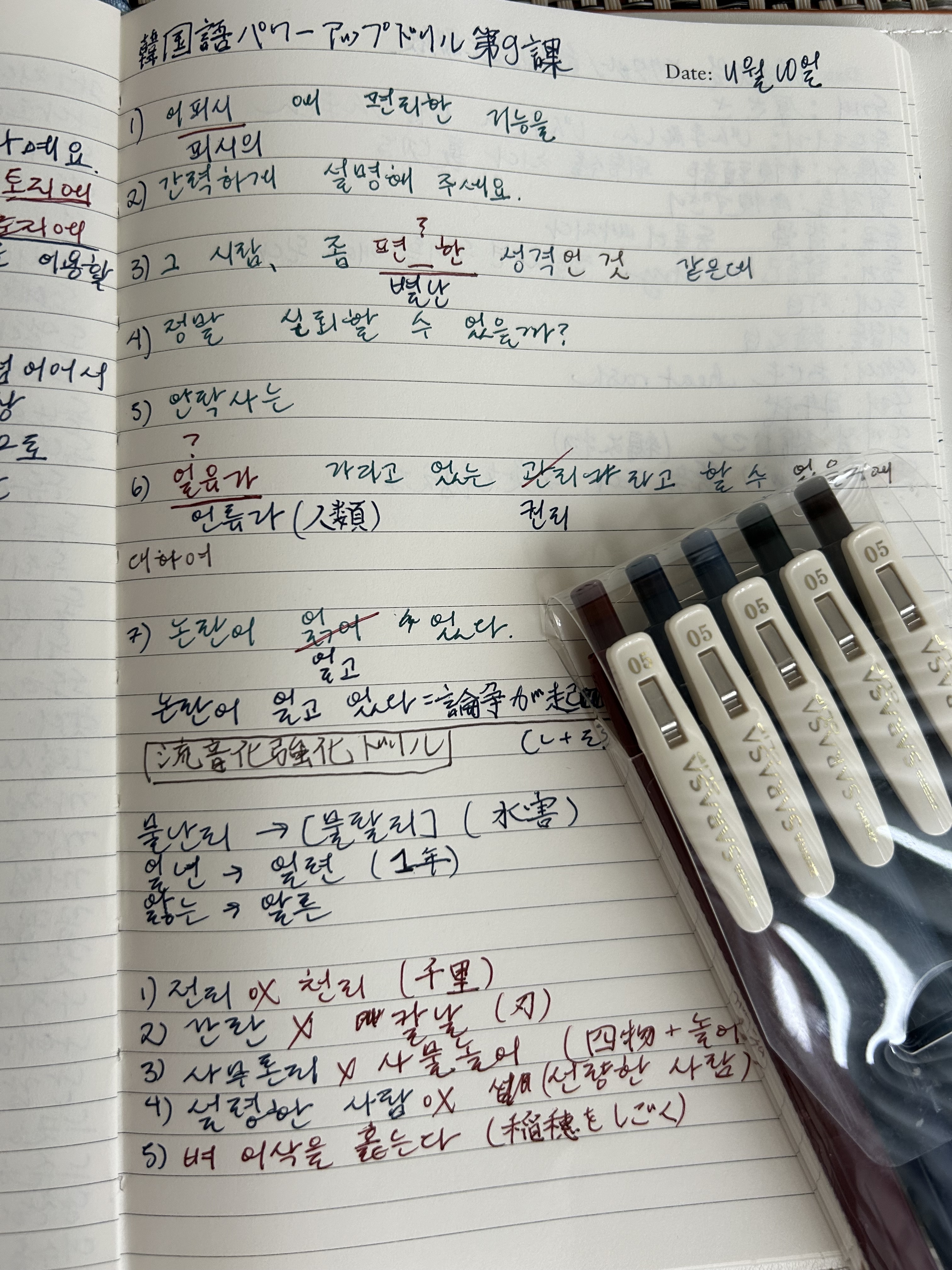
After that I did the drill at the end of the listen where you hear 5 individual words/phrases and try to recognize and write them all down and I ended up missing all 5 of them due to a combo of spelling errors/not knowing the words (the answer to the 5th one was 벼 이삭을 홅는다 ・稲穂をしごく- like PLEASE I didn’t even know that expression in Japanese lol!!).
Right after that, though, there was a column from the author explaining how interpreters take notes, tying that to the lesson, and encouraging learners to try and write down what they hear as best as they can, even if the spelling is incorrect. Only by doing so can you find the gaps in your knowledge and fill them!
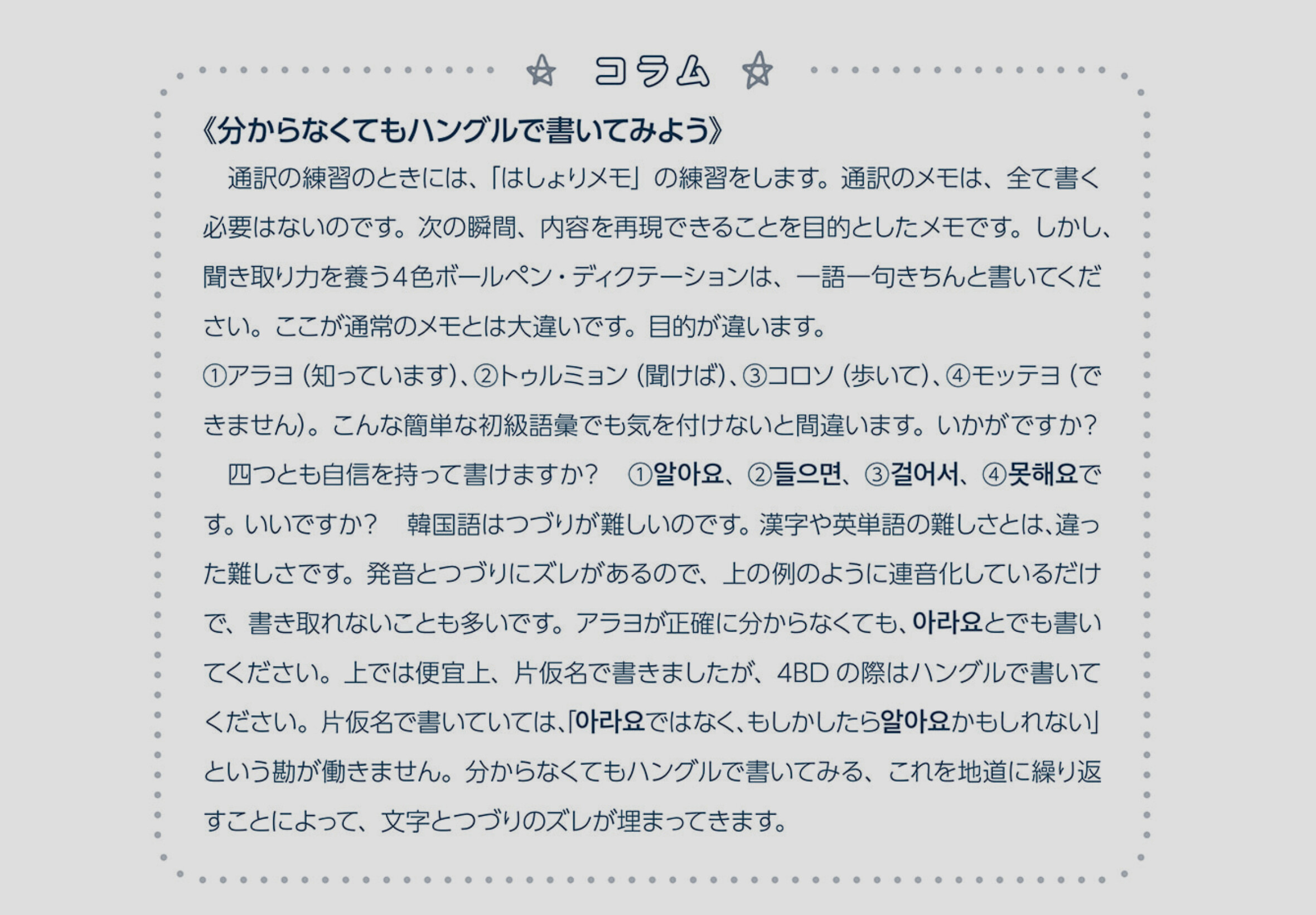
I found that note encouraging and have to say once more, I love this textbook. I totally see the vision of the author, lol. I got to practice, make mistakes, see what was wrong and fill in the gaps right away so it is working.
More Dictation
But wait, there’s more?!
After that I went back to the first section of the chapter I’ve been working through in 本気で学ぶ韓国語 and transcribed the entire audio in my notebook. It’s been a weekish~ since I learned the vocab for that section and read it, so it was like a natural SRS moment getting to review everything again. I was able to transcribe around 85% of it correctly, but there were a few words I didn’t recognize or bits of grammar constructions I heard wrong.
After I finished, I analyzed all the red ink on the page to find the things I messed up and identified a few words that I need to review (these will be great candidates for anki cards - instead of doing all the words in the chapter!) and also found a few patterns in my mistakes.
The biggest one was writing 에 when it was actually 의. For those who are not (yet! ) initiated into the world of Korean, 에 and 의 are the equivalent of the Japanese particles に・へ and の, but they sound the same in fast speech so they’re kind of hard to tell apart if you aren’t considering the context, which I obviously wasn’t. So, lesson learned! Think of the context of how it’s being used next time.
Grammar
While pulling up the audio data for 本気で学ぶ韓国語 in the audiobook.jp app to do the transcription I mentioned above, I spotted the audio for the book 口を鍛える韓国語作文 and remembered that I owned it (Wow, thanks past self! I really went wild with buying Korean textbooks last time I was in Japan, didn’t I? ), so I found it on my bookshelf and pulled it out to take a look at it. The memories all came flowing back and I totally understood why past me bought it! It’s a super awesome resource for colloquial grammar constructions and comes with both Japanese + Korean example sentences plus tons of context notes about how to use certain vocab and their nuances.
A lot of Korean learning materials from Korea are tailored towards the TOPIK exam and focus on academic language, but as someone who learned Japanese first and translates everything in their mind from JP → KR (no Jk I don’t do that….I would never:clown_face: …just sometimes…), I’ve often wondered how to say casual stuff like 〜だって?だってば、〜するつもり?、〜だなんて - basically the greatest hits of the casual N3 and N2 grammar points - and this book covers all of that plus more! So, I think I’ll work it into my routine here and there.
The only downside is that the main idea and method of the book is that you shadow the sentences and internalize the grammar point/verb ending, but the audio really sucks and isn’t ideal for shadowing at all because it has 20 seconds of random BGM at the start of each track so you waste a ton of time when you loop it, and it’s only available through audiobook.jp and not booco. I’m also too lazy to figure out how to download and edit the 60+ mp3 tracks, though…let’s see.
One interesting thing I learned from the book is that 통통하다 is a cuter version of 뚱뚱하다 (chubby). There was a note that aspirated consonants like ㅋ,ㅌ,ㅊ,ㅍ are cuter and lighter than the doubles ㄲ,ㄸ,ㅉ,ㅃ and the same thing goes for light vowels 오/아 vs 어/우. That’s the type of meta knowledge thing that’s really hard or takes a very long time to pick up on your own, so I love this textbook for inclusions of info like that alone!!! 
7 Likes
Apologies in advance for a very self-indulgent reply about reading in multiple languages and my own reading progress
I felt this in my soul Seriously, I only started learning Japanese in 2020 (yay pandemic!) and I didn’t get my reading level to where I wanted it until this time last year. While I’ve gotten my Mandarin reading to around 4,000 pages (3,000 pages is my minimum for “can read without wanting to bang my head against a wall” in terms of lookups and fluidity) the thought of repeating the 10,000+ page mark for both Mandarin and Korean (currently at around 2,000 pages read) is definitely overwhelming.
I will say that I’ve learned from my mistakes and did not start any languages besides Japanese with reading a full-blown fantasy light novel instead of, say, a contemporary YA novel. This has made my progress way faster, which helped. But it’s still very challenging to manage my time and reading energy enough to actually feel like I’m making inroads into my Korean and Mandarin reading progress while also trying to get through my Japanese TBR (let alone my massive want to read lists). And then I do want to read more than I have been in English, too…
I do want to improve my Korean and Mandarin reading more, since it reduces the energy required to read, if nothing else. Korean still has a long way to go, whereas Mandarin simply requires consistency. I can read the stuff I want to read in Mandarin (trashy entertainment industry romance novels!) without too much trouble, but I know that I can be better, so I want to read more, haha.
TLDR: Balancing reading in multiple languages is hard even if they’re all advanced, simply due to time and energy constraints, let alone at different levels. 一緒に頑張ろう!
6 Likes
No worries!! All self-indulgent introspective language learners welcome in this thread! I love reading about your experiences balancing multiple languages so always feel free to share!
10,000 is my benchmark too for “things are starting to kind of get more manageable”, but getting there is the hardest thing. I think the first 10,000 pages are exponentially harder than every increment that comes later…
I just passed over the 10,000 mark in Korean and reading is definitely starting to feel possible, but it is overwhelming and I don’t have the same drive to do it anymore.  Especially when I compare my Korean to my Japanese - I’ll think, “oh I love Japanese books and reading is so easy now, why don’t I quit Korean and read in Japanese forever?!”
I wish my levels were equal in both, but I know it will take years to catch up, which makes me shudder.
The best content. I love this type of stuff in Korean too but then it’s so tropey that it makes me rage sometimes. It’s an intense love hate type of relationship!! I can imagine Mandarin has some fun stuff, too.
Facts. I’m interested in dabbling in a few other languages but I know Korean is going to be the last one I go all in on.  Need more time…
7 Likes
This is interesting. I guess for every language I always started reading at around A2, so I’m used to the process. It’s harsh at first, but fun because I can easily see the progress through being able to read more and more complex and interesting books. Sure, it’s a big time commitment, but the enjoyement I get from reading more than makes up for it, as long as I don’t read stuff that is too high above my level. Mind you, I also don’t look up every single word though, which makes the whole process of reading and getting to a high level in reading a lot less tiring.
I actually have almost 10k pages read for Korean, but probably around 3k-4k of those are picture books. Not that I think there’s a set limit to hit to be comfortable with reading anyways, I have much less than that in Spanish but I’m at a much higher level (mostly because I was having 8 hours of a week of literature and history classes entirely in Spanish for three years in highschool, plus many hours of tvseries, so the bulk of my input was through listening).
7 Likes
This is actually pretty much how I learned German, which was the first language I was able to become advanced in! From A2 onwards I just read a ton of things and did some light grammar study. It helped a ton that it was closer to my native language of English, though. It’s kind of difficult to understate the boost you get from learning similar languages. 
I think I only have a medium amount of tolerance for ambiguity when reading in general, so doing the same thing in Japanese and Korean felt really unappetizing to me (well, I can “cheat” a lot with Korean based on my Japanese knowledge now like I did with German and English but it’s still harder).
Thinking about it, maybe I just don’t want to do the same thing twice for any language I learn cuz I’ll get bored. And I want to learn decently fast in the few hours I have per day outside of work and commuting. 
Attitude and how you approach lookups and acceptable learning speed can really make such a big difference! When your goals and desired learning speed and methods are all in alignment the fun study magic happens!! 
8 Likes
Ah, see, that’s where I’m the opposite. I can’t tolerate too many lookups but ambiguity though? I really don’t mind. I guess I’ve always been fine with it though, I was reading whole adult novels when I was 7-8, so many of the words in there I didn’t know, I just powered through anyway because reading is fun (I actually think I could grade some French books pretty well because of that, fully based on the “child me failed to finish this” criteria  )! Now that no longer happens in my native language, but I still get to do it with the languages I’m learning.
Cheating is fun. For Italian, I can come in not being able to tell for sure what 80% of the words would mean if they were in a vocab list but in context? I get it, I can understand.
Definitely. The cheat code to language learning is really just finding a method that works for you and that you enjoy doing (not that that’s easy in the first place of course)
8 Likes
Jealous for real! But, I guess you just gotta work with what you have. I think my “medium tolerance” for ambiguity drives me to look up a lot of words and learn more vocab, so I view it as one of my strengths in a way, too (I mean, anything can be a positive strength if you look at it the right way right?)
I can remember a few books like that form my childhood too.
Learning languages: the only time when cheating is acceptable?
6 Likes
I actually am curious as to what you would think of this. I would be fine with reading that text with 80% known words, just with a lookup here and there, but a lot of the words I can guess the meaning from context (even though it’s gibberish). It’s a little harder than I’d prefer, but still understandable (probably what Spy x family is around for me right now in Korean, at L28 on Japanese Natively). Obviously grammar makes it harder, but still.
Here’s what I can translate from that 80% text. As you see, there aren’t actually that many words remaining where I can’t take a guess at the meaning.
“Call for help!” you shout. “This person?/woman? is dying!” You put your fingers on her neck. Nothing. Her heart is not beating. You take out your phone and call 119, the emergency number in Japan. There’s no answer! Then you notice?/see? that you have a new voice/video message. It’s from your friend?/family member?, Evie. She works at Tokyo University. You play the message. “…if you get this…” Evie says. “…I can’t vickarn now… the important thing is…” Suddenly, she looks around, dingle. “Oh no, they’re here! Cripett… the frib! Wasple them ON THE FRIB!…” BEEP! the message stops. Then you hear?/see? something behind you…
5 Likes
Oh the examples you shared are really fun.
The 80% comprehension is what a lot of adult Korean books above level 30 on natively are like for me right now. I can deal with that if I read in chunks like 10-20 pages a day but it’s hard for me to spend hours per day reading something at that level and it’s not super fun and doesn’t really help me de-stress, which is one of my goals with reading and studying.
If I drop down to trashy web novels I can get something between 80% - 95% which is kinda the sweet spot and as much as I can ask for right now. 
80% may have been more comfy for me at one time…. But with Japanese, I’m at the 98 - 100% level for most modern books up to around level 40. I may be just too used to the luxury of being advanced in Japanese to deal with 80% in Korean, which is part of the struggle I detailed in my log post today. Do I have the time and energy to do it all again (I’m at around 100,000ish pages read for a benchmark)?! I want to, but it’s gonna be slow.
Maybe another problem is that I deal with a ton of ambiguity at my job and when I come home I just want to do some solid things where the progress is easy to feel and track so that my life isn’t one big soup of “I don’t understand” and constantly trying to process meaning.
Sorry this reply became a hodgepodge of thoughts. But typing it all out helps me understand my current reading and study needs, so thanks for asking!
Do you find that 80% comprehension is still a comfy reading level that is fun for you? How low can you go before it starts becoming unenjoyable??
6 Likes
80% is fine, but I’ll usually do it on shorter bursts, alternating between a harder book and an easier book. The breaking point for me isn’t comprehension but reading speed. Below 0.2 pages per minute, if that doesn’t quickly get higher as I read more of the book, I’ll stop. That’s actually what 소리를 보는 소년 | L29 was around for me last year, and why I ended up stopping. I probably could start it up again now though and be fine with it.
A huge part of that is actually grammar, that’s really what slows me down.
How low I can go depends on the language though, and whether I already know a similar language. For Spanish, I was reading L30 and above books at a low B1. I’m also cheating with Italian, reading A2-B1 graded readers with no previous study, just because I can, and I do understand what’s happening with a few well chosen lookups. For Spanish when I started doing reading , in terms of words known I was maybe at 50-60%. It was not comfortable by any means, but I actually almost never did lookups, because then I would’ve ended up looking up sooo many words. In the end, I had a general feeling of the meaning of each sentence that I couldn’t quite explain how I got, but as it turns out I was mostly correct in the end. I did still enjoy it, but I probably would’ve chosen easier books if I could’ve, because of how much I struggled. I can’t say if wasn’t effective though, I went from B1 to C1 in those 3 years (not even that actually because quarantine means I missed half of that last year).
4 Likes
November 11th
Did a lot of learning with auditory materials today and spent about 1 hour reviewing and studying with textbooks when I got home. After writing this I’m probably gonna go off and read for a while too. 
Listening: 1 hour (379.82/500 hours)
Shadowing: 40 minutes
Vocabulary: キクタン韓国語上級編 Days 15 & 16
Grammar: 口を鍛える韓国語作文 Days 1 - 7
All-purpose textbook: Shadowing and review of Chapter 5.1 from 本気で学ぶ韓国語
———————
Japanese & Korean Mix - Grammar / Shadowing
I’m so glad I rediscovered 口で鍛える韓国語作文 on my bookshelf yesterday! It’s perfect for reviewing grammar and getting some shadowing in during my commute. In a way, it’s hard to say you really know something unless you can independently produce it out loud, so this lets me drill the grammar and muscle memory into my brain. I can also practice both the Japanese and Korean sentences, so it’s a double win.
The only thing is the sentences are slightly unhinged??? The author either has a weird sense of humor or is going for shock value so the sentences stick in your memory, but either way I kinda love it. Today I learned good sentences such as these:
世の中の全ての男が私を愛していると思っていました。
세상 모든 남자들이 날 사랑한다고 생각했어요.
私の彼が結婚してくれないと死ぬと言ったら許可してくださいました。
우리 그이가 결혼 안 해 주면 죽겠다니까 허락해 주셨어요.
さんまさんの歯はそんなに出っ張ってないですってば。
산마씨 이빨은 별로 안 튀어나왔다니까요.
(Lmao poor Sanma, I’m sure his teeth aren’t that bad  ).
).
I mean, I always wanted to say that I thought all the men in the world love me or that I only accepted my boyfriends proposal because he said he’d die if I didn’t (toxic much? )! Thank goodness I finally know a natural and correct way to express these thoughts in Korean and Japanese!!! The grammar I reviewed today was all angry grammar like だって、ってば, 그러니까요 and the audio was so dramatic. I kept bursting into laughter.
———————
Besides that I also did more review and self-quizzing with キクタン韓国語 audio and not much to say - I feel like that’s going really well! When I learned a new batch of words today, there were a few I already learned over the weekend from the web novel I was reading so I felt happy about that too.
I also learned one Japanese word I didn’t know yet:
메아리 → こだま or やまびこ
I already knew “こだま” and “메아리” meant echo, but it was the first time I’ve encountered やまびこ! New Pokémon found! 
———————
Finally, I did some shadowing of the passage from 本気で学ぶ韓国語 that I transcribed yesterday. About 24 hours passed between when I saw it last and did the transcription, so I remember most of the words but not all of them. A few of them I didn’t catch the first couple times the audio played, but then I remembered. There were 1-2 words and grammar constructions that I couldn’t hear or remember, so I reviewed those when I got home. Tomorrow I’ll try to shadow again at full speed and get all of the words! Attacking the same material from different angles and with different methods is really helping me internalize it.
Love the process of a brand new textbook passage going from gibberish upon first read/listen to knowledge in my brain.
9 Likes
I was wondering why this one of all words seemed familiar. Turns out it’s actually in L3 of Wanikani, as 山びこ, to get that reading down for 山.
Those sentences are hilarious! Definitely a good strategy, the more unhinged, the better we’ll remember them.
4 Likes
Interesting! I’ve never used WK (I am old and it didn’t even exist yet when I started learning Japanese 
 ) but I wonder how they choose the vocab you learn as reinforcement!
Since both of the words こだま and やまびこ have popped up in different places now, I’m curious and want to dig into it:
It appears やまびこ is specifically an echo caused by sound bouncing off mountains in a valley, and こだま is more general. There are Shinkansen named after both (don’t live in Japan so I sometimes miss this type of thing).
From the dictionary:
こだま/山彦 の使い分け
1
「こだま」は、「v木霊」「木魂」「谺」などとも書き、もと木の精の意。「山彦」と違い、平地や狭い場所などでおこるものにもいい、単に、反響の意でも使われる。2
「山彦」は、もと山の神の意。山や谷で大声を出し、向かいの山から返ってくるようなときにいう。
The Korean definition of 메아리 is:
울려 퍼져 가던 소리가 산이나 절벽 같은 데에 부딪쳐 되울려오는 소리
I’ve seen it used in context to refer to an echo made by bats sonar waves, so I think it’s more like a general echo like こだま.
Interestiiiing. So I guess if you’re yodeling in the mountains, it’d be a やまびこ. Thank goodness I have this knowledge now! 
7 Likes
November 12th
Dear language diary…
Today was a bit of a rest and review day for Korean, as I ended up doing less than I have for the past few days. I also got back to doing some free flow shadowing along with an audiobook in Japanese today after taking a few days off from it, and had a few insights.
Korean Listening: 25 minutes (380.24/500 hours)
Japanese Listening & Shadowing: 40 minutes
Vocabulary: キクタン韓国語上級編 Days 17 & 18
Grammar: 口を鍛える韓国語作文 Days 7 - 16
———————
Japanese Reading
I did not touch ビジネスの未来――エコノミーにヒューマニティを取り戻す | L42??, the book I’ve been shadowing with, for a few days because I haven’t really been in the mood for economics talk. But, I felt like I needed to get back into shadowing this morning so I started it up again and actually had a good time listening to it.
The section I listened to today was about the one of the most basic aspects of fulfillment in work, which the author described as creating something or doing a service for someone directly, seeing their happy reaction and receiving thanks and but also monetary compensation in exchange as part of a socially contractual exchange. Really really simplified and there is way more involved in what constitutes fulfillment - but there is an element of community and human connection involved. It went on to expand on the idea and talk about modern workplaces and companies and how workers can be removed from those sorts of exchanges, and it got me thinking about when I feel fulfilled at work and if I do or produce anything that goes directly to an end user who I can see and connect with.
Well, that’s not what this language log is about, though is it?! I can say instead that I feel fulfilled in my language learning when I go beyond just learning words and grammar and move on to interacting with ideas and learning new things completely in Japanese. By this point, I’ve read far more books in Japanese than I have in English and part of the reason why has been my never ending quest for vocabulary acquisition, but part of it is also that I just love learning new things now through Japanese books. It’s taken a lot of time to learn all these words and understand the nuances from scratch (and I still don’t understand everything naturally), but that gives me a certain perspective and a more objective outsider’s point of view about certain things. Not to mention a whole new vocabulary and framework to understand and describe the world!
I’ll stop here! I just get happy when I’m doing my hobby and learning things and being forced to ponder the universe from a Japanese book I read - the fulfillment!  I hope everyone else out there is having a fulfilling study day.
Japanese Shadowing
So, I haven’t properly shadowed with a Japanese audiobook in maybe a week or so (wow is that true, why is time passing so quickly!?) and getting back to it today was interesting. After taking a mini break like that, it was hard to get into the flow for the first 5 minutes or so, but a noticed a few things:
- I was off on my pronunciation of a few consonant sounds, especially タ行 and カ行, but it was also extremely obvious and easy to hear that I was off so I could correct myself.
This makes me think I’m getting better at perceiving my own mistakes, which is a big part of improving! (The feedback loop, the feeeeedback looooop)
- I could pretty shadow accurately without stumbling over longer sentences or difficult vocabulary words without much effort
I think this is a case of taking a break from something for a few days and then the brain consolidating the knowledge. I’m definitely noticing a large improvement in my ability to follow along fluently since I started doing all of this. I have a suspicion that this particular aspect of shadowing would translate the most to improvements in speaking skills for my particular weaknesses (telling stories or monologue type conversations, long sentences versus ping pong type shorter conversations which I feel really comfy with), but I haven’t tested this yet. Possible ideas to test this when I feel like it could include inviting a Japanese friend to hang out or talking on the phone, or doing an italki lesson. Maybe also recording myself doing some kind of monologue or recounting a story?
I’m not necessarily interested in improving my speaking right now (I’m literally just interested in the air and tongue placement and sounds! ) since I barely ever do it, but I do think I should at least record myself talking here and there as some kind of way point for measuring progress. Soon??!
- I had more physical awareness of the changes I was making to match the Japanese audio
What does this even mean? Well, I took that break and then I’ve been doing Korean, so doing Japanese again felt slightly unfamiliar due to the contrast and it was kind of like “Oh I put my tongue hear and direct the air out here and that sounds more like Japanese.” The meant and felt like keeping my tongue lower and more relaxed in my mouth, using my nose for nasals and more a ton, and really managing airflow with my throat - imagine a mute on a guitar, it feels kinda like that? No big flowing sound waves with lots of air behind them, just controlled sounds with the breath ending after one vowel beat at the end of an word. Ahem. 
9 Likes
You’re making me really want to read that book - but if it’s really level 42 it’s probably wayyy beyond the level I can comfortably listen to! Do you think that level is accurate?
I love reading about how much you enjoy the challenge of language learning. It’s cool to hear that shadowing has benefits even for experienced learners such as yourself. I haven’t shadowed in a bit, but my tongue sometimes stumbles over words even when I know exactly what I want to say, so maybe I should get back into it. Do you record yourself, or do you just notice areas to improve as you practice?
4 Likes
Tbh I think it is probably above 42…  that’s just the auto level that was generated when I added it to natively. It would depend on your vocabulary, though! If you know some economics or philosophical terms it could be ok to read!
  I really recommend the author 山口周 in general, though! His book 仕事選びのアートとサイエンス was easier to read and also full of thoughtful reflections on working if you’re ever in the mood for something like that (it’s still interesting even if you aren’t trying to change jobs ). 読書を仕事につなげる技術 was also great but very specific.
Another recommendation by a different author that’s kind of a similar vibe to エコノミーの未来 is なぜ働いていると本が読めなくなるのか | L36. I loved it and wrote a review on it.  I saw in the listening thread that you’re listening to another book from the same author (the 推し one I think) so maybe check it out!
I’m glad to hear that! I think there is always a new challenge and learning never ends, so it’s all about having an attitude of trying out new things. I’m an experienced learner when it comes to some facets of the languages I know, but in others I can become a beginner again and try out and learn something different.
I actually do most of my shadowing while stuck in traffic on my daily commute, so logistically it just hasn’t made sense to record myself so far. I’d like to soon at some type of cadence though! Will try and figure out a plan for that mid-term ish. I haven’t been taking any of the shadowing stuff super seriously and have just been trying to rack up the minutes and discoveries about how I sound and what I hear so far, but recording myself feels like an obvious next step!
5 Likes
November 13
Dear language diary…
Just a chill update for a chill study day. Today was really Korean listening heavy, but I also got in some good grammar and vocab review from my usual sources.
Korean Listening: 2.3 hours (382.54/500 hours)
Korean Shadowing: 40 minutes
Vocabulary: キクタン韓国語上級編 Days 19 & 20
Grammar: 口を鍛える韓国語作文 Days 1 - 17 review
All-Purpose Textbook: 本気で学ぶ韓国語上級 5.1 (Shadowing) & 5.2 (Transcription)
———————
Korean Listening
I did a ton of listening today but here were some of the highlight:
-
Reviewed days 1 - 17 (everything I’ve covered so far) in 口を鍛える韓国語 and also did shadowing with the audio set at 0.5 speed to really focus on getting my mouth into the right shapes. I’ve barely ever spoken Korean in my life besides travel Korean the last time I was in Seoul, and I’m noticing that the lack of muscle memory makes it notably harder shadowing in Korean than in Japanese. I’m going to work in “slow” shadowing sometimes to do some deliberate phonetic practice and try and build good muscle memory habits! Otherwise so far so good, the sentences in this book are still unhinged.
None of the grammar covered so far is really new to me, but it’s been great reviewing it to solidify my understanding. -
Reviewed days 14 - 18 in キクタン韓国語, and learned all the words from days 19 - 20 today. I’m coming across A LOT of words I’ve already found and learned from the web novel I’ve been reading which makes me so happy!! It’s working, it’s working!!!
Both the reading and deliberate vocab study! I already know both will work for me which is why I’m doing them, but then when it does actually work and I’m learning stuff it feels amazing. Heavy breathing. -
Another thing that’s also nice related to the words I’ve studied with キクタン韓国語 so far is that when I encounter them in a book, I can hear the audio in my mind from listening to it so much. This means that I become able to sub vocalize that word in general and also correctly. There are still a lot of Korean words I don’t sub vocalize when reading because they’re unfamiliar to me or the pronunciation doesn’t automatically pop up in my head, so this is a positive development (and also one reason for why training listening will also help you read faster and better - you heard it here first!!!).
-
I shadowed the first section of 本気で学ぶ韓国語 Chapter 5 Section 1 that I tried shadowing on Monday multiple times and it went much better today. I think I’ve gotten it down! I also transcribed half of section 2 which again helped me identify a few spelling weaknesses or words that I needed to review.
-
I listened to one episode of Didi의 한국문화 podcast and did some shadowing along to it. I may just be delusional but it felt like it was crisper and easier to listen along to today, even though she was speaking pretty fast in the newest episode she uploaded.
That leads me to draw the possible early conclusion that all the listen and repeat, transcription and shadowing work I’ve been doing has improved my overall listening already. It’s kind of annoying to do that stuff because you need to sit down with headphones and audio clips and something with a script and a notebook or talk to yourself and sound silly (potentially in front of family or partners) and and and, but it’s been really high value for me so far. I’m kind of amazed with myself that I never seriously engaged with this type of stuff in all my years of study before (I’m just too content to sit and read quietly), but there is a season for everything in life and sometimes doing certain thing is just not the vibe.
Anyways it’s hard to quantify listening gains because they’re all kind of based on a best guess anyways, but I’ll keep looking for signs that may indicate overall improvement (like less mistakes when transcribing or being able to shadow longer and make out sounds, follow natural podcast or YouTube audio longer).
7 Likes
November 13
Dear language diary…
It’s Thursday! Almost Friday! I start losing so much energy every week by Thursday, but I’ve almost made it to the weekend.
Because I was a bit tired I didn’t do much textbook study, but I did finish the web novel series I’ve been reading for the last 1 month+! That is 2,500~ pages wrapped up and completed towards my goal of an additional 10,000 pages, so I am a quarter of the way there already! Yay!!! 
Korean Listening: 1.13 hours (383.67/500 hours)
Korean Shadowing: 30 minutes
Vocabulary: キクタン韓国語上級編 Days 20 & 21
Listening: 30 minutes
Shadowing: 15 minutes
——————
& Random Thoughts and Realizations
Some random thoughts and realizations while shadowing today…
I was shadowing with キクタン韓国語 and had the Korean vocab word ‘밑지다’, which is 損をする in Japanese. I realized that the nasal combo of んを sounded different that I had been hearing it in my head previously and pronouncing! I know ん is nasal, but I wasn’t nasalizing it or the vowel sound を afterwards nearly enough.
Two weekends ago when doing exercises from my Korean dictation textbook, there was a lesson about nasalizations and I swear because I did that, I was able to hear the nasal change happening with んを more clearly. It almost sounded like そㅇをする (ㅇ being the Hangul for ng) or songをする. This was a nice little instance of language transfer and my Korean studies working in harmony with my Japanese so that I can improve both.
Thinking about it, it isn’t very often that ん at the end of a word is followed by a vowel unless it is the particle を (or へ) I guess, so it should be pretty easy to remember this and look out for going forward. I had a similar realization a year or two ago about ん in the middle of a word followed by a vowel, ie 恋愛 or 蔓延 and how those shift (れngあい、まんyえん - sorry for not actually using IPA but I’m on my phone and lazy so I hope that makes sense.  Just another lesson that the shapes on the page don’t equate to the actual sounds.
——————
Today while listening to ビジネスの未来――エコノミーにヒューマニティを取り戻す | L42?? I heard and learned the word “自然淘汰”, or natural selection. A few days ago in キクタン韓国語 I had the Korean word for 淘汰 (도대) and wondered if the word for natural selection in Korean is the same since it’s entirely a kanji compound and sure enough it is! 자연도대! So I ended up learning two words for the price of one!!
——————
I did some Japanese shadowing today too and had a really good moment of some muscle memory clicking into place. This is kind of hard to explain, but when pronouncing が I feel like I was able to find exactly the right place on my soft palate, the right place on my tongue, and the right place kind of around my nose to project the sound out of and it all just came together! And I was able to reproduce it reliably, also without audio. So, now I can have one sound I always feel really confident with which is nice.
Ok, onwards to the end of the week!
10 Likes