Hello, I’m fairly new to the site as a user (although I have used it in the past for checking book difficulty), and have really only started reading seriously in the past half year or so. Despite wanting to contribute to the site, my problems are twofold:
I don’t have much experience reading (neither in English nor Japanese), so what constitutes a 5/5 book is quite unclear to me. Additionally, I’ve mainly targeted very well known novels, so giving all of these books that are largely considered masterpieces a review feels out of my depth.
While I understand that such reviews are subjective, my enjoyment of the novels are inevitably tied to my level of understanding of the material. For example, 金閣寺 is undoubtedly the most difficult novel I’ve read, so even though I found many passages beautiful and the story compelling, it was more “work” to get through than others. However, I don’t believe it is a 3 star novel at all, and I feel like I can only blame my own ability (more specifically lack of knowledge of the culture and history of the Buddhist elements of the novel) for the onerous nature of the read.
It is extremely difficult to factor in my learning curve to the grading of books. In general, I tried to keep the same level of challenge by incrementing the difficulty of novels as I went, which means that the novels I started with feel like they had inflated difficulty. Perhaps it will be easier to judge difficulty differences when my learning plateaus, but in the meantime there a couple of novels I’ve read that have little or no gradings/reviews that I would like to contribute to.
On a related note with difficulty, I imagine that the edition of the book will also alter the difficulty. For example, the newer editions of Japanese classics have a 注釈 section that helps immensely with understanding obscure or archaic terminology. In comparison, the edition of コインロッカーベイビーズ that I read not only didn’t have that kind of section, there was also scant usage of furigana (as in countable on two hands). Would that kind of difficulty be accounted for in gradings? And if so, how do you weigh kanji difficulty versus that of grammar or vocabulary?
TLDR: I’m a bit lost about giving gradings and reviews and would love to hear from others about their methods.
I think grading and reviews are very personal and there is no right or wrong way to do either!
In terms of grading, however you grade something is going to be a snapshot of your Japanese reading level in the moment vs. how it was when you read the book you are grading against. The more books you read, the easier it is to “objectively” grade and understand the levels on the site and what makes a book harder or not, but everyone is at a different place so that’s why all the grades get combined with grades from other users.
I occasionally write reviews and my approach tends to be different every time. These days I am trying to write a review for any book I finish that doesn’t have other reviews, and often they are something like a short intro into the plot and some highlights about the story and what I liked about it. Other times I feel like picking apart a book more thoroughly (typically only really literary reads that lend themselves to this, though…) and will write something longer since I enjoy doing so. Sometimes I will also explicitly talk about things that might make the book difficult to read for us non-native peeps. However, there are really all kinds of reviews on the site and imo they are all fun to read. I’d check out some others to see how people format theirs and then think about what thoughts you had about the books you’ve read, and then go forth and share!
hmmm, so gradings & reviews are pretty different beasts. I’ve already written a bit about this in another post… but beyond that:
Reviews: the main things for me are “did it make my eyes light up” and “was there anything that really pissed me off, or that I think is just Bad Writing”?
My general criteria for ratings
5 - it made my eyes light up, nothing pissed me off, and there might have been something special about it
4 - it made my eyes light up, and probly nothing pissed me off, but it just wasn’t a 5 for some reason
3 - it was ordinary to the point of being unnotable, or mildly boring, but not terrible; OR there was something in it that really upset me and prevented me from giving a higher rating
2 - the writing was bad, or there were multiple really upsetting issues that detracted from a higher rating
1 - I think this is terrible and should not have been made; or it inflicted more psychic damage on me than Evangelion did
For someone like me - who’s never heard of any of the novels on your profile - even a 2-3 sentence review like 伯父さん's review of 金閣寺 | Natively is great… doesn’t have to be that deep. Like you noted in your post: the story is compelling, and many of the passages are beautiful, but it requires a certain knowledge of the culture and history of Buddhism/Buddhist elements to fully enjoy. That could literally be your whole review, and I’d find it helpful!!
Grading: besides what I linked at the beginning, I’d say just take your best stab… If you really can’t figure it out, either click “Same” or sadly, skip. Fwiw, you can always go back later and adjust it (same with ratings & reviews)
The site will eventually get edition handling, and that will stop being an issue. However if the differences are that substantial, it might be good to submit feedback (on the book page) or tag @brandon to suggest that a separate edition be created for the book. The Product Updates & Casual Natively Discussion thread is a good place for that. Probably with the Amazon JP link for the specific edition you’re referring to.
My philosophy is that any reviews/ratings are better than none, and books/videos with gradings are much more likely to be seen by others and gather more ratings to get closer to whatever level it “should be”. So don’t sweat it too much, and remember that you can update your reviews and gradings.
For reviews, I generally put a short summary of the story (a couple sentences, at most) and why I liked it/disliked it. The bulk of my reviews then goes into the language aspect, how is the vocab, how long are the sentences, are many grammar points used? My review length varies a lot depending on how long that book was in the first place, and on whether it’s already been reviewed. If there’s already a super detailed review, I usually just tend to put things that aren’t in the other review(s).
One thing that I also very occasionally put in my reviews is a word of vocab. When a super archaic word is used, particularly if I ended up having to ask about it somewhere because I just couldn’t find a translation that made sense, it goes into the review. So far I’ve only done this with short children’s books, so the archaic word in question is easy to find inside the book.
For example here I gave the meaning of 정랑, which in the context of the book is a toilet found in Buddhist temples. It is downright impossible to find in regular online dictionnaries, and instead lots of meanings that make no sense in context pop up
My best advice though, would just be to read a lot of reviews, and to go from there, using them like a sort of template.
For ratings, 5 stars are books I absolutely loved. 4 stars, the book was good. 3 stars, something about it is bothering me a bit, but I would still recommend it. 2 stars, there’s something really wrong with this, most likely would not recommend unless you have no other options. 1 star, absolutely would not recommend. I’ve never put anything lower than a 3 star rating so far, although I’m just waiting to finish reading a certain book for that (it’s just that it is so unbelievably boring, so it’s taking me forever to finish).
Reviews are allowed to be subjective. I have read a LOT and I sometimes read a book and see that objectively it’s a good book, but I just don’t vibe with it… so it gets 3 stars and if I feel the need I clarify why in my review. Just because a book is well written or has an interesting premise, etc. doesn’t mean you have to subjectively like it. Noting in your review that your enjoyment was limited due to struggling with the language, for example, is a valuable info for other readers that might be on a similar level to yours.
(5/5 are basically perfect books for me and are rather rare but everyone treats star ratings a bit differently. )
Re gradings: I try to only grade things that I recently read, because I remember how difficult (or easy) it was and if the book I am grading against was similar or not. I don’t actively consider grammar or kanji because if I struggle with them, it just adds to the difficulty level. If you notice things like these, it’s a good idea to put it in the review. I don’t really notice most of the time. Where, I think, it does make a difference is with or without furigana. A book that is Level 28 with furigana might be 30 or more without, but it’s usually not such a huge gap that it makes gradings useless.
For star ratings: these I treat as pure “how much did I personally like reading this book?”. I give 5 for “this was amazing”, 4 for “this was great and I generally recommend it to other people”, 3 for “this was enjoyable but I probably wouldn’t go out of my way to recommend it to somebody else unless they were a fan of the genre/interested in the subject”, 2 is “bad, don’t read this”, and I leave 1 for the very rare “absolutely awful, avoid this” books.
For gradings: yeah, they can be tricky. You can always hit “skip” if you’re not sure about a pairing you’re being asked to rank.
For reviews: these are freeform, so you can say whatever you like about a book. I usually say a bit about what I liked or didn’t like, and mention anything that particularly stood out from a language learner perspective as making it easier or harder (e.g. “everybody speaks in Kyoto dialect”, “author likes to use obscure kanji”). The review is a great place to mention if you recommend people read an edition with explanatory footnotes, for instance. Sometimes my reviews are just a sentence or two: it depends a bit whether I had strong opinions when I got to the end of the book. I think even a relatively low effort review can be useful (especially if the book has no other reviews yet).
Thanks everyone for your input! I’ll definitely try my best to work on some reviews of the books with little current feedback.
One thing that I thought of that probably contributes to my confusion about ratings is that I like learning much more than reading, so if I learned a lot of Japanese from a novel (which has been all of them so far tbh), it automatically was fun and worth reading. But as a lot of you said, it’s mostly subjective so I won’t sweat it and just expand in reviews if needed!
I’ve definitely had my share of things I enjoyed b/c I learned something from them; or given them a certain language rating b/c “they’re good to pick up xyz type of vocabulary”
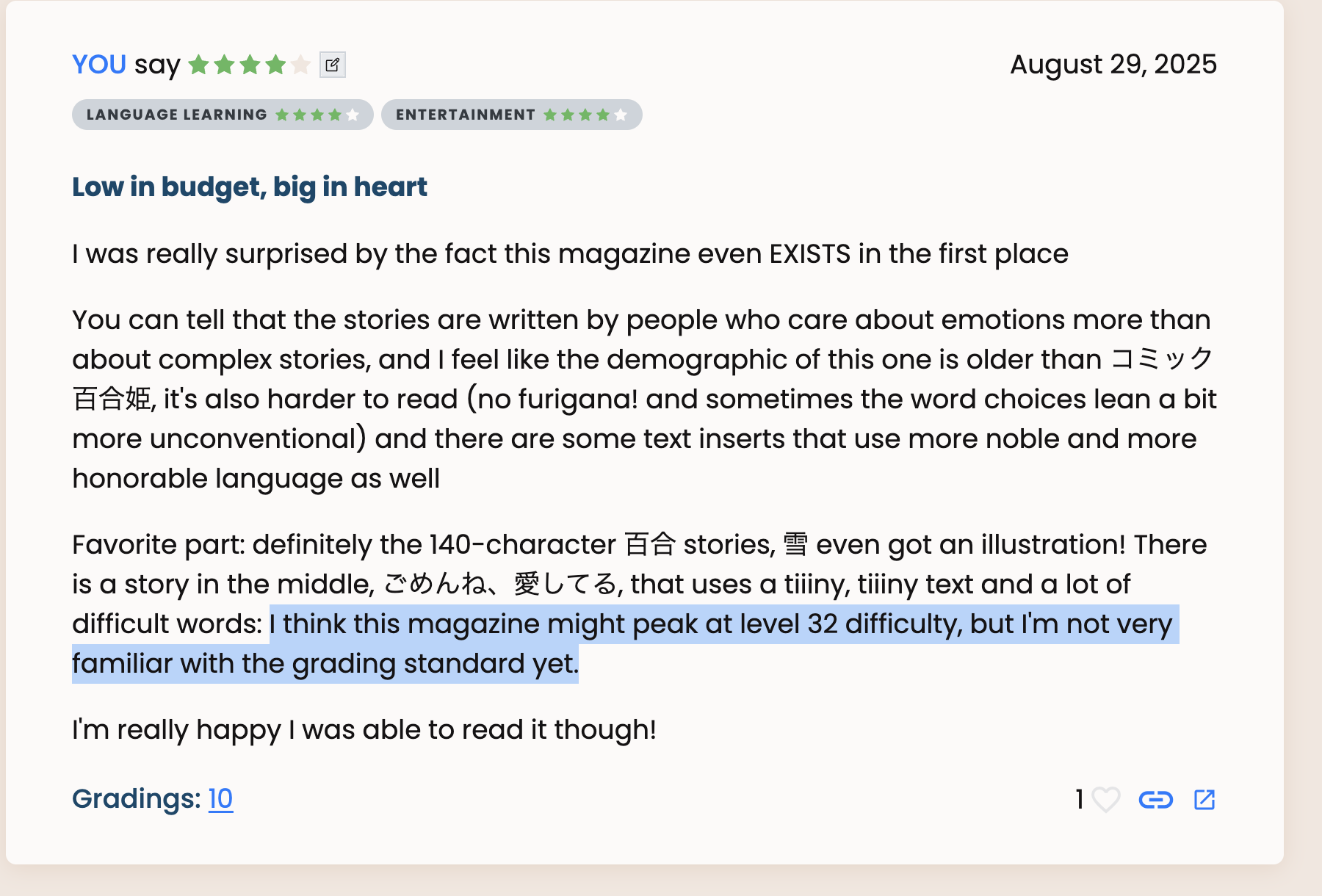
Necro’ing this topic, b/c I also have a quandry… I’m currently reading the last two months’ Yurihime magazines, and thinking about grading… the thing is the level of the magazine varies per month, and based on existing Natively series, it looks like this:
Level
Number of Series
18-23
8
24-26
8
27-28
1
29+
2
Unknown
1
2025年11月号
Level
Number of Series
18-23
7
24-26
10
27-28
1
Unknown
1
I’m wondering how would other folks here consider this when grading? Particularly - how would you weight the L27+ content, given that it’s such a minority. Similarly, there are a few columns at the end of the manga, some of which are on the upper end of difficulty (one’s about movies, one’s about vocab or culture, one’s an interview with a VA, one’s prose rambling about whatever)… they’re only maybe 10 or so pages in total (out of a magazine that’s anywhere from 300-900 pages, but usually 300-600)… would you take them into account? I didn’t used to read them - so I ignored them altogether, in my grading of older issues
I had a similar challenge for rating Harta, and I also made a table to help me rate, so that is fun. Harta also has back matter essays. I personally felt like rating it based on the average of the series (26), weighting it a bit towards the harder end was fair. But it seems the other reviewers rated it at the high end (31), even though the level 31 series were in the minority.
So the equivalent for Yurihime is: I would probably rate it like a 24-25, but I expect it might be more common for people to rate it a 28-29.
I’m not sure if that’s helpful, I guess I’m just trying to say do what makes sense to you and perhaps leave a review to rationalise it. Then someone can decide for themselves if they think it’s really exciting that they can approach nearly half the magazine if they are comfortable reading at level 23, or if they would rather get confident reading at 28+ before jumping in.
Edit: I should also say, I felt a bit more confident rating Harta lower (26) because there is a club to help people navigate it and I felt it was doable at that level. I suppose it’s worth considering at what level someone might be confident even understanding how the magazine is organised.
my heart is telling me level 26, but this is a very inexperienced heart and basically judges books based on vibes
im also a bit torn on the actual series being where they are on a table, because im currently reading something that is higher on the list of difficulties than most of the manga in this table and i’m like “where did this rating come from”
to each their own, i’m with @bungakushoujo on the rating being a snapshot of what you feel like at a given time rather than an objective grade of the qualities of the text: my heart today tells me 26 for Yurihime and 28 for Galette, as the ratio of editor/writing features compared to manga is higher there, plus either I’m not used to their kanji usage yet, or just doujin artists happen to be using more unusual words imo
i can try to check in in a few thousand pages though ^^
So they’re rating on peak-difficulty rather than average-difficulty
Never occurred to me till I was discussing it with someone on WK forums tbh. I actually thought a few series are higher level than they are on here. Which is a good reminder that sometimes I build things up too much in my head
Implying there’s other people reading it here (I know one other active reader who go into it recently, and one who has expressed interest in back issues)
I don’t usually like to leave reviews for them, since I’d have to say things about all the series I read, plus I don’t read certain series. But maybe I’ll give it a try
I think my mentality is basically "what level is required to access the vast majority of the content) - in which case the answer is L26. Up to L23 would get you about 40% of the magazine. L26 gets you about 90-95% (excuse the imprecise math), depending on the month.
Mm I approached it when my comfort zone was around L24 iirc.
actually: i’d like to touch on one other topic that is related to ratings of magazines such as 百合姫: how do we deal with context familiarity of a magazine that publishes new chapters monthly, but expects people to be familiar with the previous months’ works?
like if an arc is introduced and it establishes rules and explains some terms in an issue a few months ago, but in the current issue assumes that you are familiar with the terms and concepts and just rolling with it, does it influence the rating of the specific month’s issue?
i’m currently not reading 百合姫 so I don’t have a direct example at hand, but I think about 百合はお仕事です where there is an arc that spends some chapters explaining the rules and then references the rules in the next few chapters, but doesn’t explain them at this point
i don’t know how do I feel about this
hmmm
i really wish i could get into other people’s heads and understand how people weigh peaks vs averages there:
I don’t see that as relevant. Like if you start in the middle of any book/series/story/lecture, you’re gonna be confused. That doesn’t say anything about the book itself. Might be worth noting in a review tho.
When I was getting into it, I had to go back and read through some series I was interested in, in order to get caught up. Probably took me a few months total… It is the challenge of a magazine
If i ever get inspired to read it, we’ll see I guess. You’re making me curious, but I’m already so behind on stuff.
fwiw, I don’t include prose when it’s in manga when I’m grading it. みなと商事コインランドリー | L21 has a short story at the end of each volume, which I’d estimate is somewhere in the 28-30 level, but I don’t include that when I think of the difficulty. That still doesn’t help with the series grading being all over the place, but I’d probably aim to have my grades land around the weighted average of the grades of the individual series. I feel like that’s how I would treat an volume if it had pages and pages of very little text, and then text walls from time to time.. (looking at you, Clamp).
I also wouldn’t. A lot of ppl probly never even read them (or maybe that’s just me)
I still need to read みなと商事コインランドリー - thx for the reminder
That makes sense to me… and just like note that in the review. The only thing that gives me pause is if it’s really progress-blocking, necessary info - or else more frequent.
Maybe just the first one listed or the first one you read? And it’s OK to talk about the general character of the magazine, I wouldn’t see it necessary to go into each series
And, in this case I feel like it’s fair game to review when you feel you’re done,
even if you didn’t read everything. Based on the Harta club, I would say most people don’t read everything, although some do. For me it was helpful to think of it like a candy box and I don’t have to eat them all (or at once). I think more people would get into the amazing world of Japanese manga magazines if they knew it’s ok not to read it all and there were more reviews talking about how people get into them.
I was wondering the same thing about grading.
English isn’t my first language, and I remember feeling confident reading Murakami’s novels only when I reached a solid C1.
I was beyond confused when I saw so many Murakami’s novels in the N2 section. Keep in mind I’ve only read these in English and Italian, but how can 1Q84 be 2 levels higher than Norwegian Wood?
Two levels are not that much, and levels are not converging on some value as one would expect, but always changing on Natively, depending on who graded a book last.


 (I know one other active reader who go into it recently, and one who has expressed interest in back issues)
 やっほー
やっほー