The Lorrre-ning Log

idk what this thread is really going to be yet, but I think I’ll mostly just try to keep track of my thoughts on what I’m reading/learning (i.e. ramble, you’ll see :\ )

How I got to where I am

There’s an interactive fiction game called howling dogs that uses a paragraph from the Kenzaburo Oe short story The Day He Himself Shall Wipe Away My Tears as an epigraph. I consider myself an okay reader but I was like huh what is this even saying. howling dogs ended up being one of my favorite things the year I played it, and as a result I kept thinking about the kinda incomprehensible epigraph. So I eventually picked up John Nathan’s translation of it and later on, because I enjoyed Oe’s work a lot, A Personal Matter. At the same time, I was sort of aware of something that seemed to be emerging as the new hotness: autofiction. The direct connection of this concept to the fairly old Oe novel(la?) (at least in my head) lead me to search all sorts of things: autofiction japan, japan autofiction old?, japanese autofiction, shishokestu, shishosetsu, etc. etc.

Anyways, I came across a book with a chapter titled “Autofiction and the Shishosetsu: Women Writers and Reinventing the Self” within which there was an analysis of the 鷺沢萠 book 私の話. This isn’t translated to English, and because I had a lot of free time, I decided to buck up and learn the language by doing duolingo on and off for a couple of years - whoops. After the third or so time restarting I found the Tofugu grammar webpage and used that to get explanations (and then dropped it again).

In 2024, I picked up Duolingo - again - and then in March I dropped it - again. But this time dropping the language all together, I started going through the Genki books and graded readers. I was surprised that most of Genki 1 felt familiar (three years of on-and-off Duolingo paid off!!) but Genki 2 was mostly new (maybe not too much pay off). Then I went through various other materials (Tobira (well half of it), Satori Reader, Penguin Parallel Text (to some extent), note blogs) and at the tail end of November I decided to read a collection of short stories, 海の鳥・空の魚, that didn’t have a translation to check my understanding with and that experience felt like a big jump in terms of challenge and, also, growth.
I think it’s worth noting that I was marginally employed for a chunk of the spring and fall in 2024, so I could spend quite a bit of time most days.

Goals 2026...

See this thread

  • Spend more time listening
  • Extensive reading - read through the Gunzou issues I get this year
  • Intensive reading - shorter books
  • Translation - keep on translating passages from what I’m read; translate some of the moribito series for my nephew; translate a novella length thing somewhat competently
  • Language study - finish 初級・中上級を教える人のための日本語文法ハンドブック
Current "Study Plan"

I don’t do much structured study right now - go through Anki in the morning/during free time at work and try to read for about an hour a day. I do look up a lot of stuff in The Handbook of Japanese Grammar Patterns and in dictionaries though. I also meet with a tutor every other week to talk about what I’m reading.

Read and take notes on 初級・中上級を教える人のための日本語文法ハンドブック. Really quite interesting. Even when discussing simple things I think I already understand it frames it in a way that I feel like I am getting stuff out of.

Currently Reading: グロテスク by 桐野夏生

Really good. Far too long for me currently, but I’m suffering through it lol

Novels/Short Stories/etc that I like

I feel like I have a high hit rate in terms of liking what I pick to read, so I’ll need to come up with something so this doesn’t become just a list of everything I’ve read.

  • 黙市 by 津島裕子
  • 海の鳥・空の魚 by 鷺沢萠 – particularly 東京のフラニー, 卒業, 天高く, 涼風, and カミン・サイト
  • ジャッカ・ドフニ 海の記憶の物語 上 by 津島裕子 – dnf but I liked what I read
  • 葉桜の日 by 鷺沢萠
Goals 2025...

*be able to understand spoken language better

At this point, I feel like I have little to no ability to understand speech, so I kinda want to get better. oops all books backfired a bit I guess. I resubbed to Satori Reader for a month and will try to listen through some stories because the writing is simple enough that the main challenge will be hearing what is said, if that makes sense.

*read faster

I think this will come with time, so I’m not too worried about needing to do anything specific to reach this goal. I can also see getting better at listening being helpful with this.

*work through a good bit of The Routledge Course in Japanese Translation

I got this a little earlier this year and have been putting it off because I feel like I only get one really good shot at working on the exercises that I don’t want to waste because I decided to start before I was ready.

*read 私の話 by 鷺沢萠

umm this was the text that got me to try and learn Japanese in the first place, so I’d like to read it this year and I think that’s a reasonable goal – although I have a paper copy which is harder to read and takes a lot longer than I expect (which is already a pretty long time :|

*read ケナリも花、サクラも花 by 鷺沢萠

another text I became interested in before i started learning the language. I came across it in the article Constructing the self in Megumu Sagisawa’s and Miri Yu’s travelogues: a case study of two Japan-based female writers of Korean origin

*maybe finish ジャッカ・ドフニ 海の記憶の物語 上 by 津島裕子

I read this for a little longer than a month and got halfway through ish but it’s a bit too tough for me right now so I’d like to revisit this later in the year to see if it goes a bit smoother because it’s really interesting to read and think about.

Previously Read

河童 by 芥川龍之介
葉桜の日 by 鷺沢萠

12 Likes

It looks like this is your first post? Welcome :slight_smile:

ちなみに I only learned the term 私小説 / I-novel pretty recently (while learning about shoujo/Class S history). Cool to see someone mention it

Feel free to join the April 2025 Listening Challenge if you’d like (you don’t have to set a number of hours or anything, it’s fine to just log or reference things you’re listening to). Satori reader is such a great resource for improving this!

I love that book!

What exactly is that book about? The blurb on Amazon just described Akutagawa in general, but not the book itself afaict

4 Likes

Yes – sorry if I missed an introductions thread. I kinda looked but not too hard…

Thank you that sounds fun!

It’s framed as written recording of the ramblings of a psychiatric ward patient to a doctor about the patient’s experiences living in kappa society (although, right now, the psychiatric ward stuff seems to mostly be a frame for the story – like the doctor doesn’t cut into the narration). It’s a satire and it’s kinda broad in focus so the experiences the narrator tells span a lot of facets of life – so like one chapter has the patient remembering a piano and cello concert, another has him explaining factories, and other chapters are about family relationships of the kappa.

Edit:
Re the 私小説 and Class S connection - do you remember any thing in particular you read about this connection? I don’t really know much about Class S, so I’d be interested in reading more about it and how it relates to i-novels.

1 Like

That sounds either really weird or kinda interesting. I can’t decide

There isn’t any. That just happens to be where I personally stumbled across the term, specifically reading about the author 吉屋信子

Class S literature is basically early shoujo/the shoujo of its day (early 1900s, but you still get it in literature as late as the 50s), and oriented around romantic friendships or (usually) platonic romance between school girls or women. It was also a type of relationship in real life (and I imagine whether it stayed platonic IRL was much more varied, but it was taboo, and in literature that wouldn’t have passed the censors).

If that might be of interest, there’s a book club. We’ve mostly read the more modern works so far, but we did read one from the 1930s (乙女の港).

2 Likes

I forgot I have a bad habit of forgetting to post on forums :/

I finished 河童 a little while ago, and in my initial post I mentioned how it felt breezy due to the short chapters and that held true for the most part, but there were also parts that were really challenging. For example, at one point the narrator is given a book and one chapter of 河童 is just short one or two sentence excerpts from that book. This was pretty challenging because the excerpts are fairly abstract and also due to there not being a ton of context – they felt sort of like list of maxims.

I started reading the first essay in ケナリも花、サクラも花 because my copy came in the mail, but reading physical books is still a bit to uncomfortable to do away from my computer, so I switched to reading something on my e-reader (which I can comfortably read in bed :)

I started reading 葉桜の日 by 恵鷺沢 and, outside of the dialogue, it seems to be going well. I really like how this author stylizes dialogue. She writes added, emotive syllables with katakana – like なアに for なに. I really struggle with speech contractions, so this way of writing gives me one less thing to dedicate brain power to parse. I’ve also come across the “grammar point” that fries my brain the most… 「…さえ …ば」. I don’t know why, but it really makes me work overtime.

I also (briefly) looked at chapter 5 of The Routledge Course in Japanese Translation, because someone described it as making the point that “Japanese is not actually that ambiguous” which piqued my interest. Anyways an earlier exercise was to translate the following tanka which I present for you to think about:

この時間君不在を告げるベル
	どこで飲んでるだれと酔ってる

I’m curious about how other people interpret this

My ideas and thoughts (hint: I went off path)
[1]
This hour, the church bell informs of your absence
	Where are you wine-drunk and with whom

[2]
This season, the caroler's hand bells tell of your absence
Mulled wine from where and with whom

[3]
Right now, at this hour, your absence rings bells
	And I can’t help but wonder where you are drinking and who all is there

A big struggle for me here was understanding what ベル meant. The dictionary gloss was “bell” but like what type of bell? I wondered. I wrote [1] kinda quickly with the first “bell” that came to mind that could be associated with absence.

I wasn’t quite satisfied with that (in a lot of ways), and (un)fortunately, I knew the word 鐘 so I searched ベル 鐘 online which pulled up pictures of little hand bells. These are something I only really have association with Christmas carols in movies and while I know [2] is super off mark for a good translation, I’m the type of person who would keep thinking about it, so I just wrote it down to move on.

[3] was the result of a few things and, honestly, I’m fairly happy with it (not to say it’s perfect or good – “your absence rings bells” is a turned around, for example). One was thinking “what if ベル is more abstract/figurative here?” and the other was remembering a short story where the main character goes to a bar he frequents and the (older) regulars are all gathered there after their friend’s funeral. So I started thinking toasting and cheers-ing to the memory of someone could maybe possibly be construed as a bell sound of sorts, so I tried to write something that matched that vibe of a kinda warm sadness.

What the book alleges

The book makes the point that “almost all native speakers of Japanese recognize the bell in this poem to be the sound of a telephone ringing” and that the author’s non-native students commonly interpret it as “a doorbell” or “a clock” (p. 140). The association with the telephone would (allegedly; although, I guess I have no reason to doubt) bring to mind someone calling their lover who doesn’t pick the phone up and wondering what their lover was up to. Which is 100% not something I got, so there is still plenty left to learn!

Anyways I’m getting a headache from being on my computer too much or allergies or thinking too hard or something – bye now

2 Likes

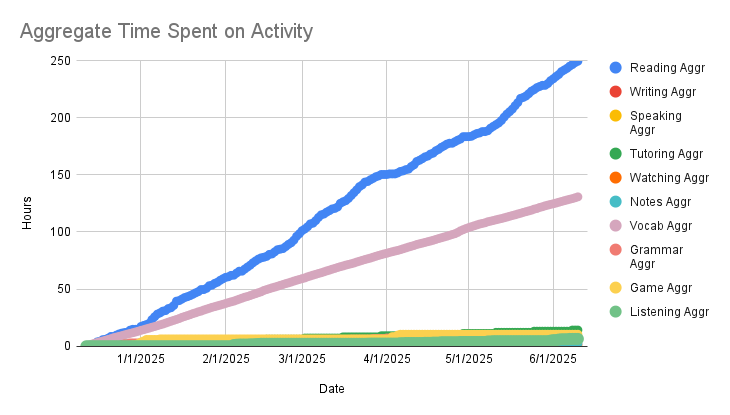
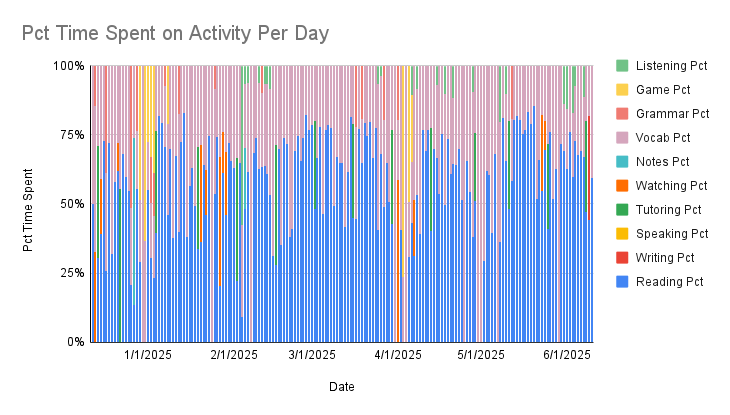
I was looking at my time tracking spread sheet and noticed that I just hit 181 days (which means by the time I’ve finished writing this I’ll be at 182 days (half a year – right?) [well, I was tired yesterday so I’m actually posting at 183 days – I might need to edit this a bit (so apologies if it’s a mess)]) so I decided to share some graphs and do a little ‘learning’ write up for the big things I read

Daily Time Breakdown (Graphs!)


I think the thing to see here is that there are two things I do - vocab and read. As evidenced by the thing I’ve spent the third most time on being tutoring which is an hour every other week. So to say that I’m lopsided is an understatement. I feel like I want to be a little less lopsided, but, at the same time, I guess my actions show that I don’t really care. Like it’s interesting that I spend my time in a very focused manner (when I read, I have to be solely reading; same for vocab), but I don’t really spend time doubling up things (like doing errands/chores and listening to something, for example). Although, I’ve recently started reading stuff on Aozora that have audio recordings, so I sometimes follow along with the audio (and count it as reading time). To some extent, I think it feels like I have to go back to like graded reader level for listening and that now seems kinda boring in a way it didn’t when I was just finishing Genki. I’d really like to get my reading time to be 2x vocab (which is just anki time basically) and I think I’m on track to do that in a month or two.

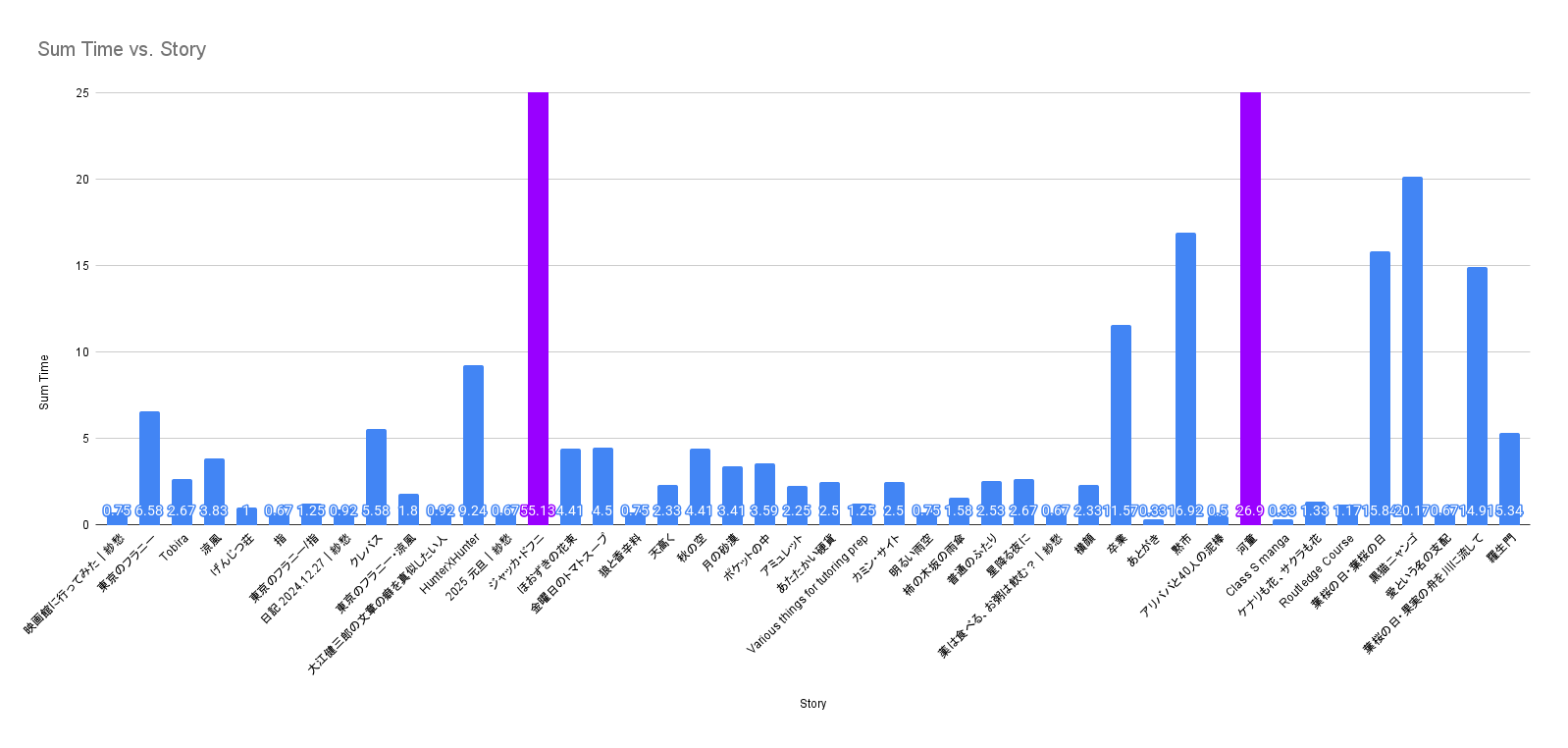
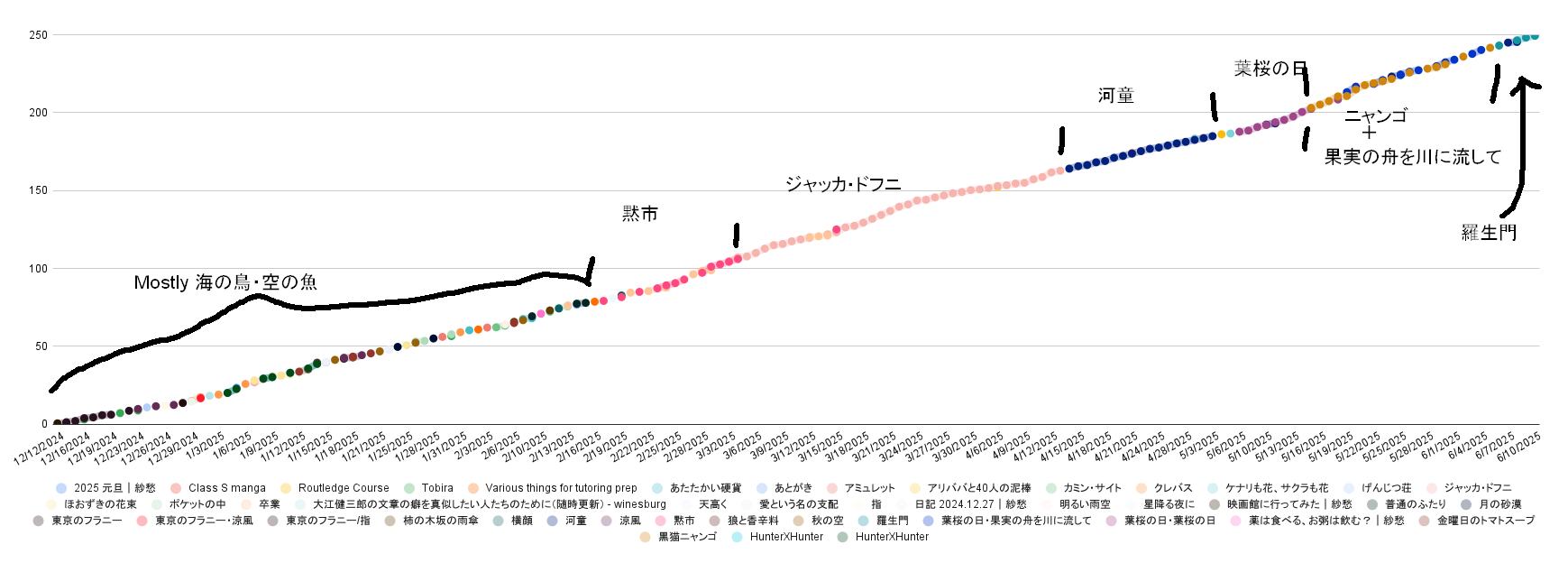
Time spent reading stories (More graphs!)

Purple bars mark stories I’ve read for more than 25 hours. Bear in mind that this includes time spent re-reading sections/stories.


海の鳥・空の魚 - ~60k characters
I actually started this around Thanksgiving (USA). I don’t know how intentional I was when I chose to read this as my first book without a translation to check against, but it was a very good choice. The book contains what is known as the “very short story” (20 of them) so I didn’t have to psyche myself up too much to start reading. All the stories are set in modern Tokyo so it was fun to look at a map and figure out where certain things were happening (even if the map of Tokyo gives me vertigo). The stories all have the characters dealing with the malaise of modern life but they also have a pretty wide range - one (涼風) was about a guy who worked as a delivery driver for a factory, another (クレバス) was about a someone picking up his car after it was impounded, a third (卒業; my favorite or second favorite) was about a girl graduating school and not really having any idea what to do. The variety was nice because it introduced me to new vocab pretty constantly (well it’d be hard not to). I think (I don’t really have any easy way to check this) I ended up getting about the same number of vocab words from each story due to everything shifting. It took me a long time (hours-wise and calendar-wise) to read, but I also re-read each story around three times to understand them decently well enough. My strategy was read once with a dictionary, once working through tough sentences with a grammar resource and then a final time reading a bit more fluently (although still needing to look up words). The super short length of each story was super helpful for sticking with this process.

黙市 - ~10k characters
I think this is the best thing I’ve read in terms of language learning. The vocab used in this story felt incredibly approachable, but the story was quite challenging to understand because Tsushima has a narrator who approaches stream of consciousness. This style really highlighted aspects of reading that I was ignoring that seem fundamental. Previously transitional phrases had felt like a little spice added to a dish that I could kinda ignore, but in this short story there were times where it felt like me getting the sentence was balanced on those. Also she writes with longer sentences so I really had to practice keeping things in my head.

ジャッカ・ドフニ - ~60k characters read
Kinda hard to believe that I only got about a quarter of the way through the book despite spending 1/5 of my total reading time from this half year time span on it. Challenge-wise keep everything that I liked about the previous Tsushima story but add on a bunch of little things that together make it tough to read like dialect, focused vocab, and a historical context I was largely unfamiliar with. I would gobble up an English translation because the book is 100% in my wheel house - it’s just a bit much when dealing with the L2 veil. Although, due to my own stubbornness, I would still be reading it now, three months later, if my tutor didn’t suggest to maybe put this down for a little (although I was also reading less and less in the time span leading up to dropping it). I definitely feel like I learned something reading this, but what exactly I can’t say.

河童 - 35k characters
This was a bit easier (the sentences were shorter at least), but still quite challenging. I think the hardest parts that I haven’t written about in this thread were the references throughout and places where a kappa character replies with something close to a non-sequitur. The references were mostly European in nature, so not too bad to look up, but still there were quite a few. I think if I had a larger vocabulary this would have seemed more challenging, but I still need to look up quite a few words when reading so encountering 第四階級 doesn’t seem that much different from the more common word 憎悪.

葉桜の日 - ~40k characters
果実の舟を川に流して - ~40k characters
Two novellas by the same author as 海の鳥・空の魚. I’m not sure I have too many concrete takeaways with regards to learning - just that it felt kinda comfy to return to an author I was familiar with. I guess, the dialogue was probably the most challenging part. Despite it being clear who was speaking and when it was a speech affect (なアに for なに), it was still pretty tough to understand what people were saying at times due to how casual it was. (refer back to my tracked hours and the amount of time spent listening : /)

黒猫ニャンゴ - ~80k characters read
This was the first novel/story I’ve read written by someone who is not well renowned in the literary world. I approach it pretty casually (meaning I only occasionally re-read paragraphs or sentences not everything). It’s nice to have something that I don’t feel a compulsion to re-read until I ‘get’ it; as long as I have the gist I’m more than happy to keep floating through this book.

羅生門 - ~5k characters
I think this must be read as part of middle or high school because a lot of times when I would find a particular phrase or sentence tricky there was a chiebukuro post asking about the phrase in question. With Kappa (by the same author), whenever I searched for an explanation of a tricky part it was mostly links back to Aozora and sometimes a note blog post using the quote. Not to say that this was easy for me to read (I had a big misunderstanding early), but it felt approachable.

If anyone wants my spreadsheet format to generate their own graphs/track their time, I can share that.

3 Likes

It’s almost the end of the year and it’s been a while since I last posted here, so I have two reasons to post. Still, I feel like I don’t really have much to say; I mostly kept on reading. I stopped tracking hours in late September/early October because I got busy with work and things, and my time spent reading also took a dive then. I feel like I haven’t quite recovered to where I was. I did make a list of books that I want to read and so I’m trying to finish my current one, so hopefully that motivates me a bit.

My current book is good, but it’s a 上・下 volume type of thing where each volume individually is the longest thing I’ve read (although, they’re not super long in the absolute sense at 200k and 220k characters respectively). Something that I realized is that I can’t really read long books yet. Or, rather, long books that I have an literary interest in. The sort of analytical interest can easily double the amount of hours it takes to read while also limiting the amount of hours I can invest the mental energy I need to. Like the 上 volume took me a month and a half or two months to read (granted I started in late September reading lull), and after I finished it, I read a 140k character book in like a week and a half. It seems like the more time I spend on a book the slower I end up going. Luckily the next four books I have listed are all under 100k characters. So smooth sailing I hope.

Also, lately, I’ve been questioning how well I actually understand what I read. The most recent book I finished was 闇の守り人 (the week and a half read). It felt like I understood most of it without a dictionary (there were still a bunch of new/forgotten words), but at the same time hmm I don’t know. I guess it’s mostly that within the idea that I can read certain things “comfortably”, there is a certain amount of complacency that, if left unchecked, will stop me from truly advancing.

In reaction to this, I’ve kinda re-started a more structured and methodical approach to the language. After I stopped reading Tobira around chapter 8 (Jan or Feb 2025), I just looked things up as I came across them. And it’s not that I feel like I went stagnant during this time – this morning I read the chapter in Tobria that I left off on and it was pretty easy and I was aware of all the grammar points it introduced – I just feel like I’m missing a lot of fundamentals. Not that I can really say why I feel this. But, anyways, I made a list of “language skills” books to read and started working through them the other day. Things like All About Particles or Jazz Up Your Japanese with Onomatopoeia. After I finish those, I want to move onto the 初級・中上級を教える人のための日本語文法ハンドブーク books. I skimmed a little of each one and am pretty excited because them get into the weeds about grammar and the subtleties of certain constructions.

Regarding the goals I set for 2025 in the main post, I don’t think I met any of them. Some of them (namely the ones about reading a specific book), I feel I could have done, but I prioritized other books. I did get through a couple chapters and exercises of The Routledge Course before moving on to translating passages from whatever I was reading, so maybe I could say I accomplished that one.

The goal I was the farthest from accomplishing was the “improve my listening skills” one. I don’t know, it’s really tough because I don’t do a lot of activities that incorporate listening. As an illustration, I got a subscription to hbo max a little while ago because it was really cheap and there are some shows that I am interested in watching, but, as of now three weeks in, I’ve watched one episode of Deadwood. So it’s like I have to change my habits to get better at listening, but I don’t really care to. Strange

I think I’ll hold off on coming up with goals for the new year for a little. I have some ideas now, but I’m still thinking about some things.

5 Likes

Ah, I’ve read this and enjoyed it, though it gets pretty academic at times. I also started doing the exercises, then realized they were taking 3x-4x as long as reading the book, then got lazy, haha. Still, it’s a pretty good resource imo; I should go back and re-read it one of these days.

I’ve had this same issue; listening/watching stuff doesn’t like a main hobby in my everyday life, so I’ve had to purposefully make room for it in Japanese. I set a goal to listen to an hour a day last year, and that ended up working pretty well so I’m doing the same this year. That way the listening was less “I should really do this!” and more just part of my study routine.

3 Likes

So in the interest of having some accountability on the goals I set in the 2026 Goals thread, I’m going to try a every other week update here. The four things I wrote about there were 1. listening, 2. extensive reading, 3. intensive reading, 4. translation. I am now realizing that the reminders I set on my computer are for a different four things which is a little oopsie.

Listening

Not too much unfortunately. This was one of the things I didn’t set up as a daily reminder/checkbox so I only did it intermittently. I think a bit of an issue I’m facing is that because I would get listening through media, I’m more likely try and read my book for an hour because I really want to finish it.
I did watch a bit more of the skyrim stream, but I think at various points I dozed off. The downsides of getting too comfy.
I think I will end up taking @eefara’s advice of purposefully dedicating time to this area. I’m not sure if I really like watching old streams and will probably try to listen to the Moribito audio books and read along.

Extensive/Intensive Reading

I’ve been kind of lazily reading recently in an effort to finish my book. Not really spending the time I need to in order to consider it intensive and looking up too many words to call it extensive. I think I will have finished it within a week so I can hopefully figure out how to split my time between sources like I described in the 2026 goals thread. I do read an hour most days which is good, but

I feel like in this post I’ve been like ugh I can’t wait to finish this book" a lot, and I don’t want to give the impression that it’s a bad book or that it’s uninteresting – it’s not.
I guess I’m just at a low point in terms of how I feel about my ability to understand the language and to some extent I think these bad feelings are tied to how long I’ve spent on this.

Translating

I had some grand plans in the goals thread, but right now I’ve just been plugging away on translating sections of 夢十夜 for tutoring . I haven’t worked on it everyday, but I do think having the check list has made me a bit more consistent.
Something that I like about this sort of exercise is that it forces me to confront the sentences that I don’t understand. It’s always fun when I’m uneasy with some section only to realize the thing I misunderstood happened earlier and has snowballed.

Thing I forgot: Explicit Language Study/Notes

I think I got a bit muddled in that I wrote about this in my last learning log post, but not in the goals thread.
I found it somewhat surprising that I am pretty consistent with reading and taking notes on a grammar resource. Like I start a timer, take notes on whatever and then I’ve met my hour a day study goal.
This is probably due to it feeling low stakes or something. The grammar resource I’m reading now, 初級を教える人のための日本語文法ハンドブーク, is written in Japanese, but even so it feels a little like a retreat for some reason. I think its because I find myself reaching for this instead of my book because it’s less of a struggle; the explanations are pretty clear and, outside of grammar terms, the vocabulary is pretty easy. Anyways, I’ve been finding this sort of thing pretty enjoyable lately.

yeah I think I want to go back and read the rest of it. I found the exercises pretty fun, so I’ll probably do the ones that seem interesting, especially if they have an “answer” in the back for me to think about the decisions I made and the decisions made in the “answer”. I also never made it to the fifth chapter which was kinda my entire reason for buying the book.

2 Likes