not a typo

Indeed - that was my worry too 
and we have a big cliffhanger…
Well whaddaya know! Such a funny word. I certainly won’t forget it now. Thank you 
Welcome to Week 12!
| Week | Start Date | Chapter | Page Count |
|---|---|---|---|
| Week 12 | Dec 20 | Chapter 17 | 18 |
Mark your participation status by voting in this poll.
(Please feel free to update your status whenever you like!)
Photo by Fethi Benattallah on Unsplash
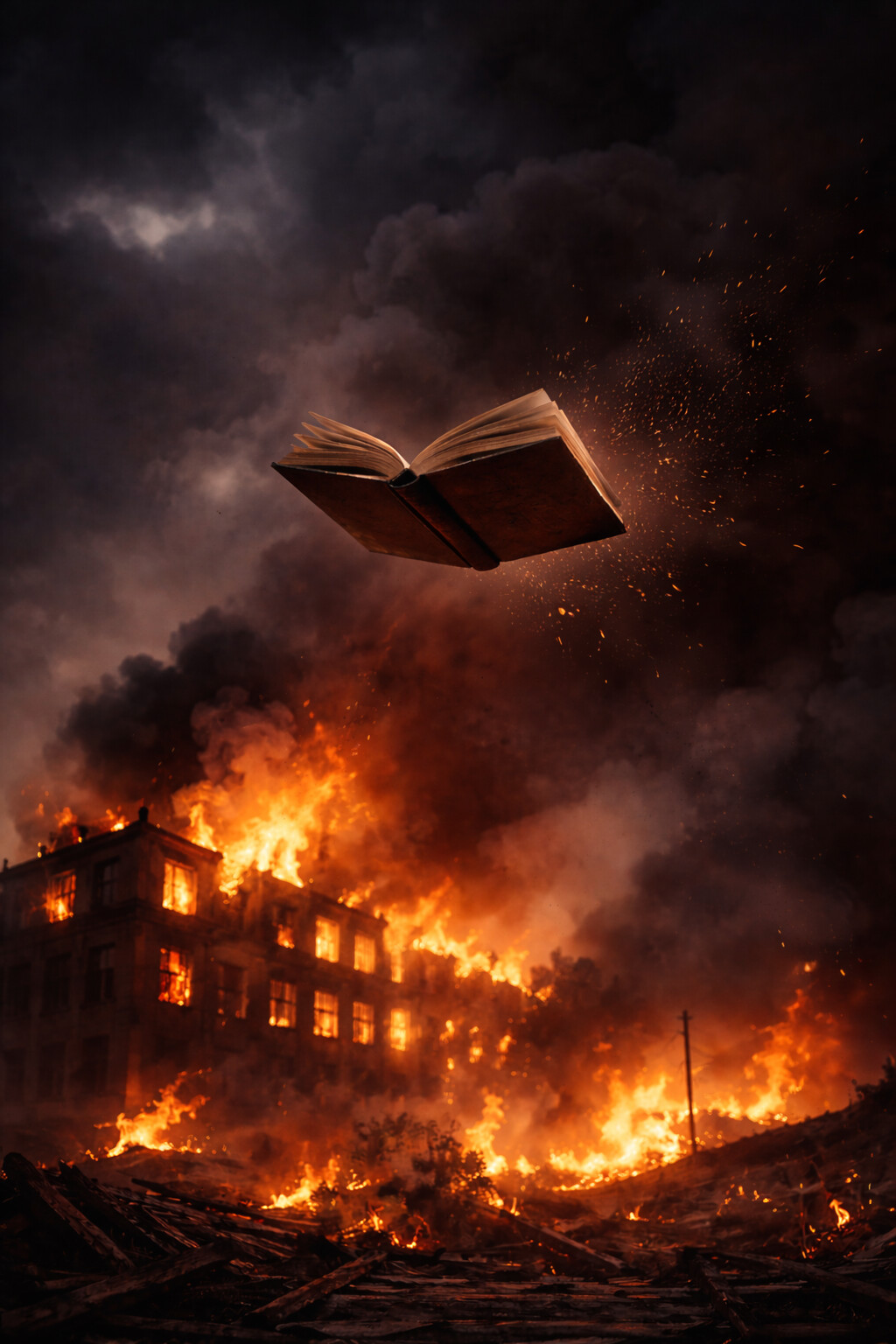
I’m not sure if I was more nervous in the last chapter, when I was waiting for the potential knock at the door when the three were mid party, or in this chapter when the police were marching through the house. The section with the overturned carpet corner was very tense (I loved the image of the burning diary, fluttering down in the darkness to the river).
Had to go back and check - the neighbours to the East were the working couple who were not very friendly to the neighbours (and hadn’t been willing to spare any heating fuel). Now we know why…
The end of the chapter, and the inevitable (or so it has seemed) happens. I’m not sure how we are supposed to feel about our narrator’s relationship with her hidden refugee. Is this a forgivable bringing together in the crucible of intense stress and anxiety? Or is this an unpardonable betrayal of R’s wife and young child? What do you think?
Lots of exciting action!
It was very lucky that the 記憶狩り bought the meal prep excuse, and that they didn’t find the funnel-speaker. I’m imagining how much of a psychological burden it would be to try to ensure that any such signs of R’s presence are invisible at absolutely all times. Impossible!
There was a sentence near the beginning of the chapter that I found mysterious:
夜の静けさの中で、おさえようもなく張りつめたものが漂っていた。
おさえようもない makes me think of something big that you’re trying to press down on. 張りつめた makes me think of a taut wire, outward tension. And 漂っていた (Ogawa loves this verb) makes me think of something soft and flexible, or even vapor, moving gently. So basically, this sentence mashes up three completely different mental images. What did you guys think of this?
It kind of feels like both to me. On the one hand, it’s understandable, considering the intimacy and the shared stress of this situation. On the other hand, it’s thoughtless and cruel to R’s wife.
I still can’t get much of a read on R. I feel like I hardly know more about him now than I did when he first moved in. His unshakable composure is downright saintly, and that kind of weirds me out.
Slightly late, but: Welcome to Week 13!
| Week | Start Date | Chapter | Page Count |
|---|---|---|---|
| Week 13 | Dec 27 | Chapter 18 | 17 |
Mark your participation status by voting in this poll.
(Please feel free to update your status whenever you like!)
Image from Wiki
There are interesting developments and tensions in both the ‘real’ world, and the imaginary story within the story.
One observation is that in both places, there is a disorientation with the loss of the ability to distinguish days and dates.
In the clocktower, the proclivities of the typing instructor are getting stranger, and even more controlling. I continue to be interested in thinking about why our main story narrator is drawn to write this very dark story. It presumably some form of response to life under the thumb of the memory police. (Perhaps it is significant that her response to the stress of their recent search leads her to inflict even more degradations on her character).
[I was struck by an interesting meta-observation. The reader (at least this reader) is tempted to psychoanalyse the ‘author’ to examine why she might be drawn to torture her female character in this way. But of course, presumably people do the same to 小川先生. In a number of her stories (this one, but perhaps most notably Hotel Iris), her female protagonists find themselves in quite dark abusive relationships. Presumably people might ask 小川 what this means about her own relationship with her husband. She might reply that it doesn’t mean anything - this is after all fiction, not autobiography. If that is her response, then perhaps we are (I am) also mistaken to seek explanations for our narrator’s writing.]
to be continued
Hi Ogawa fans. I finally got around to reading this in English over the last week or so and have just caught up to where you are. It’s been a real pleasure reading all your comments as I finish each chapter. I don’t think I’ve seen a reading group with such thoughtful and reflective comments on the story!
Reading the comments has certainly made me miss not reading this in Japanese. Although reading your comments has made me feel not completely disconnected from the Japanese. I even added 形見 to my flashcards!
I wouldn’t have been able to find time to read this in Japanese at present, but I’m so glad to be reading it in English. Such an intriguing and captivating story. It has been interesting how strongly this book feels like an Ogawa book. I saw so many parallels with 妊娠カレンダー.
I’m fascinated to see where this story goes. There are some really mysterious aspects at present and I wonder how gratifyingly these can be resolved. I will be reading ahead of you now but I promise no spoilers
Hi Micki,
great to have you join us, even if in English! Do feel free to join the conversation as we read on.
I read the book several years ago in the English translation and really enjoyed it. That has certainly made it easier to read now in Japanese (though I had forgotten most of the details).
We have a lot of the story-within-the-story in this chapter, and there are some striking images.
It isn’t totally clear whether it is her persistent voiceless state, or her imprisonment, but in several places she seems to be describing a sense of depersonalisation and disintegration. In one section (if I read correctly), she seems to imply that her lack of voice is worse than being imprisoned.
[Perhaps it is the complete lack of agency that results from the voiceless state, and the dependency that this creates?]
閉じ込められていることより、声が出ないことの方がずっときつくわたしを縛りつけています。彼が言うとおり、声を奪われるのは肉体のまとまりを崩されるのと同じです。
In another place, when noting that she can no longer remember what her voice sounds like, she imagines her body being taken apart and mixed with the body parts of others. She would be unable to recognise her own eyeball (?)
Later, when contemplating the prospects of escaping, she seems to imply that even if she could escape the tower, she could not return to her normal self. (She thinks that she has lost the ability to understand anyone else’s language except that of her captor).
It is difficult to know what to make of these reports. Presumably, this is the effect of the teacher’s coercive control. Like other abuse victims, (and perhaps explicitly or implicitly encouraged by her abuser) she has a form of learned helplessness. Her beliefs that she cannot escape, and that even if she did not escape, she could not live without him - these are perhaps not unusual thought patterns in victims of abuse.
But of course there is a more literal reading. We don’t know the cause of the typist’s mutism. Perhaps she is physically and psychologically disintegrating due to some obscure process.
*I’ve been drawing parallels between the mental state of the imprisoned typist and the state of the islanders. The latter are subject to their amnesia - possibly paralleling the typist’s mutism, as well as coercive control by the secret police. If that parallel is correct, then the additional thought from this chapter is that the islanders have a sort of learned helplessness. Apart from the rare escapees from the island, the remainder do not resist the memory police, nor try to escape because their state renders them passive and powerless.
Seriously, I opened my book today and the words had disappeared! I’m hoping that turning it off and turning it on again is going to fix this, but if I look out the window and there are no birds…
Chapter 18 was one of my favourite chapters. Like with some of the similar scenes in 妊娠カレンダー, it’s so beautifully and gently written that the horrific elements are even more striking. One moment you feel like you could be reading about the healing hippo of Hinode Park, and the next moment you are hit by images of piles of body parts.
I don’t think I could recognise my eyeball if it wasn’t in the usual context of being in my face. I see it every day so I’d like to think I would, but I expect I wouldn’t. I was also interested in the concept of whether I could find my left eyeball. If it were my hands dismembered in a pile of body parts, I could work out the left and right one fairly easily (it usually takes me a few moments to figure it out), but I’m not sure that’s so easy with eyeballs.
The passive acceptance of fate in both the islanders and the typist in the novel are both really striking parts of the story. I think in most books if the typist were trapped in the clock tower by her lover, we would get scenes of banging on the door, trying desperately to pull it open, screaming out the window for help etc. Instead we get this really ominous, creepy, passive acceptance of the situation.
For the islanders, it’s a really striking idea of how a state can gradually nibble away at a population’s liberties, and they can fall in line with simply accepting the new norm.
Image from ChatGPT
Disappeared things:
Our long chapter this weeks begins with a small list of unusual events - the old woman in the street, the tense overnight stay of the quiet neighbours and the abandoned dog.
The first of these is interesting. When the old woman casually asked our narrator if she knew of anyone with a safe house, I was quietly yelling at our narrator to say nothing - surely this must be a set-up.
But the more I read, the less convinced I was of this. I shared the narrator’s misgivings, but it strikes me that the most likely explanation is that the old woman was just desperate.
What did you think? Was this real or a trap? How would you tell?
It was interesting to see R’s reaction to the news of the latest disappearance. It struck me that this episode exemplifies the interesting difference in views about the nature of the island’s malady between those who are and who are not affected by it. R seems to think that our narrator (and others) can resist the disappearances if they try hard enough. The memories are not gone - they are just buried. And the implication is that if our narrator simply refuses to accept this loss, that she will not be affected by it. But she tries to explain that it is already too late. The ideas/meanings relating to novels are already evaporating.
[For those who are interested in the metaphorical reading of the novel, one possibility is that this echoes the way that sometimes people act as if those who are affected by progressive memory loss can remember if they want to, or could slow the progression of their illness by force of will, or practice etc (sudoku anyone?)]
It is also interesting because it brings R and the narrator back together again. At the end of the previous chapter, the aftershock of their night of consolation seemed to have pushed the two characters apart. Our narrator even suggested that the manuscript was the only thing connecting them. (The narrator never mentions the possibility, but presumably R was consumed by guilt at betraying his wife, hence his sudden change in mood). But with this news, R seems to have returned to his plan to help narrator and the old guy to restore some of their memories.
Another interesting clue in this chapter is that there is the first suggestion that maybe R is right. Our 主人公 finally realises what the raving girl in the park was wearing on her head. And she finds herself remembering birds in that striking final image when watching a book fly into the pyre. So perhaps the island amnesia is not as permanent or complete as it is made out to be.
[[another link to dementia here. it is a fairly familiar phenomenon that those who are affected by Alzheimer’s or other forms of dementia may have moments of remembering or of lucidity. Sometimes they surprise caregivers by remembering a face, or an event that on other days they seem to have completely forgotten. Has anyone else ever read the wonderful children’s book Wilfred Gordon McDonald Partridge by Australian author Mom Fox?]]
Sorry everybody for the delay! I finally returned from my travels and should be back on track from now on 
Here is week 14:
| Week | Start Date | Chapter | Page Count |
|---|---|---|---|
| Week 14 | Jan 03 | Chapter 19 | 35 |
Mark your participation status by voting in this poll.
(Please feel free to update your status whenever you like!)
Hi @Micki ! Glad to see you here! 
I have been sick, and am playing catch-up again. I don’t have anything interesting to say about chapter 18 at present, just that I found it very unsettling!
Welcome to Week 15!
| Week | Start Date | Chapter | Page Count |
|---|---|---|---|
| Week 15 | Jan 10 | Chapter 20+21 | 28 |
Mark your participation status by voting in this poll.
(Please feel free to update your status whenever you like!)
Lots of events in these chapters.
Thank goodness @nikoru didn’t leave us with the big cliffhanger at the end of chapter 20.
First there is our narrator’s new job, with the interesting but unsettling connection to her now largely forgotten story. We have the impression that the memories of the typist are somewhere below the surface of her consciousness.
The narrator tells the old guy of her abortive attempts to continue her writing. It seems as though perhaps the loaned typewriter is going to help her to access her memories, but it doesn’t seem to be working, at least not yet.
There is a very interesting passage that I highlighted, that my Kindle tells me 38 other people have highlighted. It is about the relationship between fiction and reality.
小説なら誰にもとがめられないそうよ。つまりゼロから作り上げて行けるの。目の前にないものをあるかのように書くの存在しないものを言葉だけで存在させるのだから、記憶が消えても諦める必要は無いんだって。
It speaks very much to something that I reflected on a few chapters back. I speculated that the narrators story might be telling us something about her inner world or about her deepest desires. And I also wondered about what these stories told us about Ogawa’s mental life or persona life. Here at least she seems to be deflecting such questions. Fiction is made up, it doesn’t need to be based on real life. It can even be an 嘘
R氏 clearly has in mind that the act of writing might be therapeutic for our narrator. It doesn’t matter if they have lost their memories, because fiction doesn’t rely on real experience. (At this stage, both the narrator and the old guy are sceptical). Interestingly, I did find some links to “writing therapy” - creative writing as a tool for patients with dementia. Will link to it when I get a chance.
Then there is that really dark, brief exchange just before the dramatic end to o the chapter. The old guy has clearly been observing or suspecting that something is going on. Our narrator doesn’t deny this. But then she asks in her turn an awkward question about whether R will ever leave the secret room, whether he will ever return to his wife and children.
Her own answer to this is intriguing, particularly the last part
外の世界へ出て行ったら、無理矢理水面に引き上げられた深海魚みたいに、彼らがばらばらにちぎれてしまう。だから、私は彼を抱きかかえて、海の底に沈めているの。
What did you make of this last part?
The next chapter is very dramatic and tense.
I was surprised that the narrator and おじいさん weren’t talking about or worrying about R when they were on the boat or perhaps especially on the hillside. But perhaps they were too busy saving themselves.
Sounds like they made a mess of the trapdoor. Do you think おじいさん will be able to fix it, or will they need to find a new hiding place for R?
Welcome to Week 16!
| Week | Start Date | Chapter | Page Count |
|---|---|---|---|
| Week 16 | Jan 17 | Chapter 22+23 | 32 |
Mark your participation status by voting in this poll.
(Please feel free to update your status whenever you like!)
There are some moving developments in this chapter.
This includes the apparent fate of the 乾 family. Probably predictable, but reminds us of the danger that lies in wait for our main characters, and also of how just how lucky they were in getting through the earthquake unscathed and undiscovered.
(There is a horrible alternative ending to this book, easy to see how it could have happened, where the narrator and the old guy drown in the tsunami, and R dies trapped in the secret room…)
I am worried about おじいさん. We have some clues here that sound worrying. He doesn’t have 蕁麻疹, but there is something not right…
But most of the chapter is taken by the discovery of the items secretly concealed by the narrator’s mother. What connects a ferry ticket, a mouth organ and some ramune candy?
At first it seems a very odd collection of items.
(Anyone else remember a similarly strange miscellany of items, including discarded musical instruments on the floor of the old chocolate factory in one of Ogawa’s short stories?)
But they seem to be united by being precious 形見 to our narrator’s mother. And it is interesting to see in this chapter the first sense that maybe there is a way back to their lost memories for the amnesic islanders.
[One thought - the discovered items are described as
形の上ではどこにも共通しているところはないけれど、どれも慎ましげで密やかで甘美な雰囲気を持っていたからだ。
And I wondered whether actually the mysterious 密やかな結晶 of the title refers to the way in which memories have been ‘crystallised’, preserved hidden inside these abstract sculptures?]
There are some lovely memories that are stirred up by the discovery of the secret objects. The narrator’s memories are vague - of her mother sharing with her some of the items that she had preserved. But there are the much more detailed memories that R氏 shares.
One possibility that occurs to me is that these different items stimulate different senses. So, the ticket is described in rough in texture - the little fragment of folded paper when held in finger tips might bring back memories of past trips (when the islanders actually used to leave the island). The harmonica of course generates sound and stirs auditory memories. While the ラムネ generate a taste memory.
(We don’t have anything to stimulate scents. I wonder if the perfume will return later in the story?)
I mentioned a couple of chapters ago, my own memory of a lovely children’s story (Wilfred Gordon McDonald Partridge) that is all about the way that precious items can sometimes be a key to unlock buried memories for those with memory loss. That seems particularly pertinent to this chapter.
And the chapter closes with a lovely, but slightly cryptic final image - very typical Ogawa. The narrator listens in rapt silence to the stories by R, まるで神様が空から降らせてくれるチョコレートを一つ残らず受け止めようと, スカートの裾を広げて待っているかのような気分だった。
goodness that was tense…
I’m not sure I’d have been able to accurately impale my cucumbers after undergoing that sort of stress. (But I’m still worried about おじいさん)
I’ve finally caught up. Phew.
I’m sorry, y’all—I’ve been picking away at this, but I’m not sure I’m going to be able to finish this book. I have some stuff going on in my personal life, and I just can’t handle any more bleakness right now. Knowing Ogawa’s style, things are not going to turn around and suddenly reach a happy ending.
Maybe I will come back at a later date—or just get the English translation from the library so that I can fly through it.